Featured Snippet Answer
Building integrated photovoltaics (BIPV) are photovoltaic materials integrated directly into building envelope elements such as facades, curtain walls, roofs, skylights, and shading devices. Unlike conventional solar panels mounted onto buildings, BIPV products serve both as construction materials and as power-generating components.
Explore BIPV System Options for Different Building Envelopes
From facades and curtain walls to roofs and custom photovoltaic glass, different BIPV routes fit different project goals. Explore the system options that best match your building type and design priorities.
Table of Contents
Introduction
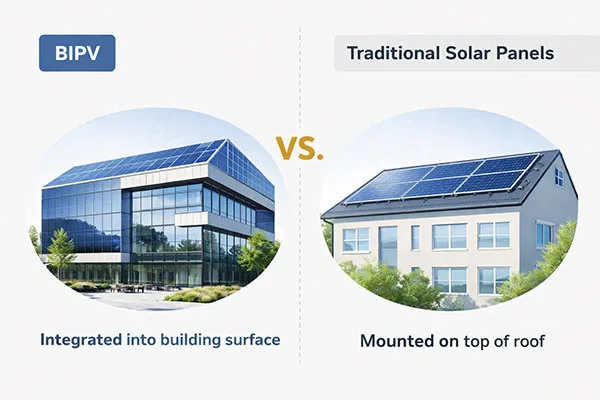
Building integrated photovoltaics, or BIPV, is no longer just a niche architectural idea. For many commercial buildings, public projects, and design-led developments, it is becoming a practical way to combine building envelope performance with on-site power generation. The core difference is simple: conventional PV is usually added onto a building, while BIPV is designed to become part of the building itself. In other words, the photovoltaic element is not only generating electricity, but also functioning as part of the roof, facade, glazing system, skylight, or shading structure.
That distinction matters more than many project teams expect. Once PV becomes part of the building skin, the conversation changes. It is no longer only about watts and payback. It becomes a question of envelope design, visual integration, material replacement, documentation, coordination, and long-term project value. That is exactly why architects, developers, facade consultants, EPC teams, and building owners look at BIPV differently from standard rooftop solar.
In practical terms, BIPV makes the most sense when a project wants more than “solar added later.” It is particularly relevant when the design team wants the building envelope to contribute to energy generation, sustainability positioning, and architectural expression at the same time. For some buildings, that means a photovoltaic facade. For others, it may be roof-integrated modules, semi-transparent photovoltaic glass, a skylight system, or a curtain wall configuration that balances appearance, daylight, and energy production.
This guide explains what BIPV means, how BIPV systems work in real buildings, where they are used, what benefits and trade-offs buyers should understand, and how to evaluate which BIPV route best fits a project.
What Is Building Integrated Photovoltaics (BIPV)?
A simple definition of BIPV
The most practical definition of BIPV is this: it is a photovoltaic product that is also a building product. According to IEA PVPS, a BIPV module is both a PV module and a construction product, designed to be a component of the building. If it is removed, it must be replaced by another building product because it performs a building-related function in addition to generating electricity.
The most practical definition of BIPV is this: it is a photovoltaic product that is also a building product. According to IEA PVPS, a BIPV module is both a PV module and a construction product, designed to be a component of the building. If it is removed, it must be replaced by another building product because it performs a building-related function in addition to generating electricity.
How BIPV differs from traditional solar panels
The simplest way to explain the difference is to compare BIPV with BAPV, or building-applied photovoltaics.
BAPV is mounted onto an existing building element. Rooftop solar racking is the classic example. The building is already complete, and the PV system is attached to it later.
BIPV is different. The photovoltaic component is integrated into the building envelope from the start, or it replaces a conventional building material. That could mean roof-integrated products, photovoltaic facade cladding, semi-transparent PV glazing, or a curtain wall element designed to generate electricity as part of the building skin.
From a project perspective, that changes everything:
- The design team must think about appearance and detailing earlier.
- The supplier must support both electrical and building-envelope requirements.
- The value discussion includes both energy and replaced material function.
- The approval and documentation path is usually more involved.
Why the term matters in architecture and construction
BIPV sits at the intersection of architecture, facade engineering, energy strategy, and sustainability. That is why the term matters far beyond the solar industry.
For a commercial building, a BIPV system may be evaluated as part of the facade package, glazing strategy, net-zero roadmap, or ESG positioning. For a public or landmark project, it can also become a visible sustainability feature. For industrial and campus-scale projects, the logic may be more performance- and area-driven, especially on roofs and larger envelope surfaces.
How BIPV Systems Work in Real Buildings
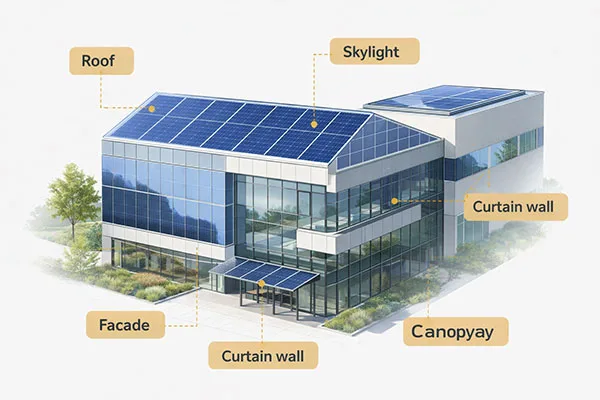
Where photovoltaic materials are integrated
In real projects, BIPV can be integrated into:
- facades
- curtain walls
- roofs
- skylights
- canopies
- awnings
- sunshades
- pergolas
- other exterior envelope surfaces
This is important because many buyers still assume BIPV only means “solar roof tiles” or “special solar glass.” In practice, the application range is much broader.
The dual function of BIPV materials
A standard PV module mainly performs one task: electricity generation.
A BIPV product has to do more. Depending on where it is used, it may also need to provide:
- weather protection
- enclosure
- thermal performance
- daylight control
- privacy
- architectural finish
- shading
- structural or semi-structural integration
- visual consistency with the rest of the building
That is why BIPV selection is not only a solar decision. It is also an envelope decision.
Common system configurations
The most common BIPV configurations usually fall into a few categories:
Opaque BIPV modules
Often used where appearance, cladding replacement, or roof integration matters more than transparency.
Semi-transparent photovoltaic glass
Used in skylights, canopies, facades, and some curtain wall applications where daylighting and visual openness still matter.
Laminated or insulated photovoltaic glass
Relevant in glazing-led applications where safety glass structure, thermal performance, and envelope integration must all be considered.
Facade and cladding-oriented systems
Used when vertical building surfaces are being activated for power generation and architectural expression.
Main Types of BIPV Applications
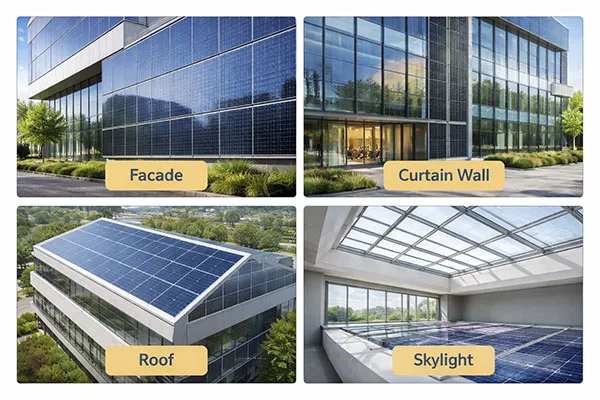
Facade-integrated BIPV is often one of the most commercially attractive applications because it turns a highly visible part of the building into an active surface. For commercial buildings, offices, public buildings, and design-conscious developments, this can create value beyond energy alone.
A facade-led BIPV strategy is especially relevant when the project wants:
- a strong sustainability identity
- better use of vertical surfaces
- an integrated architectural language
- a building skin that does more than simply enclose
In dense urban projects or taller buildings, facade area may also become strategically important when roof area alone is not enough to support the project’s renewable energy goals.
BIPV curtain wall systems
Curtain wall BIPV is one of the most technically and architecturally ambitious routes. It is usually considered in premium commercial buildings, institutional projects, and design-led developments where the facade system already plays a major role in identity and performance.
The main appeal is clear: instead of treating the curtain wall as a passive glazed skin, the project can make parts of it power-generating. The trade-off is also clear: once transparency, daylight, glass structure, output, detailing, and code requirements enter the same conversation, coordination becomes more complex.
This is why curtain wall BIPV is rarely a “simple product purchase.” It is a system decision.
Roof-integrated BIPV is often one of the most direct and practical routes because roof surfaces already have a strong relationship with solar access. In low-rise commercial and industrial projects, the roof may remain the strongest starting point.
Skylight and canopy applications are different. Here, semi-transparent photovoltaic glass can create a more balanced combination of daylight, enclosure, and generation. These applications are especially attractive in atriums, public entry zones, canopies, and design-led overhead spaces where visual impact matters almost as much as output.
Benefits and Trade-Offs of BIPV
Architectural and commercial benefits
BIPV’s first major advantage is architectural integration. It does not have to look like a later-added utility layer. It can be designed as part of the building language from the start.
That matters because many developers and architects are not only evaluating energy yield. They are also evaluating:
- facade quality
- building image
- tenant perception
- sustainability visibility
- material integration
- long-term asset differentiation
In many cases, the ability to combine electricity generation with building-material function is exactly what makes BIPV strategically attractive.
Technical and project benefits
From a technical and project perspective, BIPV can also offer:
- multifunctional use of building surfaces
- material replacement value
- more integrated design outcomes
- expanded generation opportunities beyond the roof
- stronger alignment with net-zero and envelope-led design strategies
For some projects, especially taller commercial buildings or highly visible facades, this is the real advantage. Rooftop PV alone may not be enough, or may not match the project’s architectural goals. BIPV broadens the design options.
The trade-offs buyers need to understand
BIPV is not automatically the better choice in every case.
The most common trade-offs include:
- higher design and coordination complexity
- more documentation and system review
- stronger dependence on early-stage planning
- a more involved interface between facade, structure, glazing, waterproofing, and electrical design
- in some applications, lower power density than conventional opaque PV systems
- a balance between appearance and output rather than output alone
This is the part many simplified articles skip. In most projects, the real decision is not “Can BIPV generate electricity?” The answer to that is yes. The real decision is whether the project values integrated envelope function enough to justify the additional design and coordination effort.
How to Choose the Right BIPV System
Start with building type and project goal
The first question is not “Which BIPV product is best?”
For example:
- A landmark office tower may prioritize facade identity and ESG visibility.
- A campus or public building may prioritize design integration and educational value.
- An industrial building may prioritize surface area use and long-term performance.
- A premium mixed-use building may care about both appearance and sustainability storytelling.
That project goal should shape the BIPV route from the beginning.
Match the system to facade, roof, or glass requirements
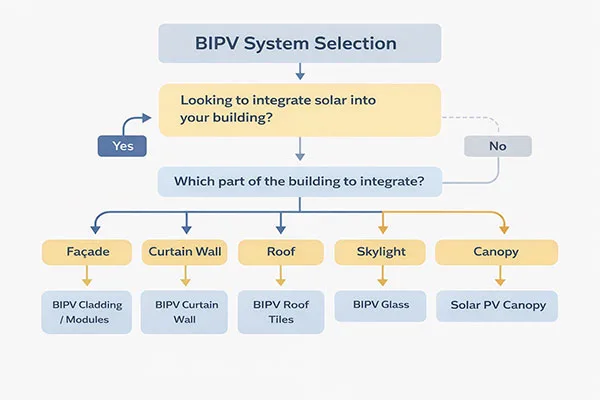
A practical selection logic often looks like this:
Choose facade-oriented BIPV when the vertical envelope is a strategic design surface.
Choose curtain wall BIPV when the project already depends on a high-value glazed envelope and wants integrated generation.
Choose roof-integrated BIPV when usable roof area, practical energy generation, and envelope coordination matter most.
Choose custom photovoltaic glass when transparency, daylight, color, and architectural finish are central to the design.
In other words, the right system is driven by application logic, not by keyword popularity.
Review customization, documentation, and supplier support
In real procurement, projects do not fail because the concept sounds weak. They fail because detailing, documentation, and coordination break down.
That is why teams should evaluate:
- size and dimension flexibility
- glass structure options
- transparency range
- color and appearance options
- electrical performance targets
- samples and mock-up support
- drawings and datasheets
- test reports and certification pathway
- project communication capability
The safest choice is usually not the product that looks most impressive in a brochure. It is the supplier path that can support the project from concept through technical review.
Is BIPV Right for Your Project?
Best-fit project scenarios
BIPV is usually strongest in projects like:
- commercial buildings with visible facade value
- public buildings with sustainability goals
- premium mixed-use developments
- office towers with limited roof opportunity
- industrial and campus projects where roof or envelope integration makes strategic sense
- design-led buildings that want sustainability without a bolt-on appearance
When conventional PV may still be the better choice
When conventional PV may still be the better choice
- the project is mainly output-first
- the lowest upfront cost is the main decision driver
- architectural integration is not a priority
- the building envelope is already fixed with little design flexibility
- the team wants minimal coordination complexity
This is worth saying directly because BIPV is not supposed to replace every PV application. In many cases, the smarter strategy is to choose the route that fits the building’s actual goals rather than forcing BIPV where it adds little value.
Next steps for evaluation
If a project is considering BIPV, the most practical next steps are:
- define where the application is likely to be: facade, curtain wall, roof, skylight, or custom glass
- collect drawings and basic building information
- clarify whether the priority is appearance, generation, net-zero positioning, or a combination
- shortlist the envelope zones where BIPV can create the most value
- request preliminary technical review before going too far into detailed design
That approach saves time and usually leads to much better product matching.
Why This Article Can Be Trusted
This guide is based on established BIPV definitions and technical references from IEA PVPS and NREL, both of which describe BIPV as a multifunctional building product that combines building-envelope function with photovoltaic electricity generation. They also note the wide range of BIPV application routes, including roofs, facades, skylights, windows, awnings, and other building surfaces.
For project teams, the practical takeaway is straightforward: BIPV should be evaluated as an envelope-and-energy system, not just as a solar product. That is the mindset that leads to better design decisions and more realistic project outcomes.
Final Thoughts
Building integrated photovoltaics is not simply a more aesthetic version of solar. It is a different project logic.
Once photovoltaic materials become part of the facade, roof, glazing, or shading system, the evaluation framework changes. The project is no longer only choosing a way to generate power. It is choosing how the building envelope should perform, look, and contribute to long-term value.
That is why the strongest BIPV projects usually start with the building itself:
- What surface should become active?
- What balance is needed between output and appearance?
- What balance is needed between output and appearance?
- Which system route best matches the design and technical workflow?
If those questions are answered early, BIPV can become far more than a sustainability add-on. It can become a meaningful part of how the building is designed and how the project is positioned.
FAQ
What is the difference between BIPV and solar panels?
Is BIPV more expensive than conventional PV?
Can BIPV be used in curtain walls?
Are BIPV systems suitable for retrofits?
Does BIPV glass generate less power than standard modules?
What information do suppliers need for a quotation?
About BIPVSYSTEM
BIPVSYSTEM provides building-integrated photovoltaic solutions for modern building envelopes, including BIPV facade systems, curtain wall systems, roof-integrated systems, and customized photovoltaic glass. We support project teams with preliminary product matching, customization discussions, and technical documentation preparation for real building applications.