If you are searching for thin film BIPV efficiency, you are probably trying to answer a bigger question: when does thin-film or flexible BIPV make more sense than conventional crystalline silicon in a real building project?
The short answer is this: thin-film BIPV is usually not the first choice when the only goal is the highest module efficiency on a simple roof, but it becomes very interesting when the project needs low weight, design flexibility, curved surfaces, semi-transparency, or better building integration. That is why this topic matters. Thin-film BIPV is not just about chasing lab numbers. It is about where a different PV format solves a building problem better than a standard panel can. DOE’s BIPV definition supports this framing by describing BIPV as photovoltaic materials that replace conventional building materials in parts of the building envelope.
In recent public articles, thin-film BIPV is usually presented as lighter, more flexible, and more architecturally adaptable than crystalline silicon, but also less efficient in mainstream commercial form. One recent 2026 guide, for example, puts thin-film BIPV systems around the 10%–15% efficiency range in typical market discussion while highlighting their flexibility and aesthetic integration.
That basic description is useful, but it is incomplete.
More importantly, the real decision is not “Which technology looks more advanced?” The real decision is which technology fits the roof, facade, structure, budget model, and maintenance reality of the project in front of you.
Table of Contents
What Thin-Film BIPV Actually Means
Thin-film BIPV refers to building-integrated photovoltaic products that use thin photovoltaic layers rather than conventional thick crystalline silicon wafers. In BIPV, these products may be used on roofs, facades, skylights, membranes, or other building surfaces. The current BIPV landscape includes thin-film membranes, semi-transparent glazing units, colored facade products, and emerging perovskite-based concepts
In practical terms, thin-film BIPV is usually discussed in three groups:
1. Conventional thin-film BIPV
This includes technologies such as amorphous silicon, CdTe, and CIGS in building-integrated forms. These technologies are not new, but they still matter because they offer advantages in flexibility, lower weight, and appearance options. The IEA PVPS guidebook includes examples of flexible amorphous-silicon BIPV modules in real building use.
2. Flexible BIPV
Flexible BIPV is more about format than one single chemistry. It usually refers to modules or laminates that can adapt to curved, lightweight, or non-standard surfaces. This is especially relevant in roof membranes, retrofits with load limits, and some architecturally sensitive surfaces.
3. Perovskite BIPV
Perovskite BIPV is the most talked-about future direction because perovskite solar cells combine strong efficiency potential with design flexibility, including transparency, color tuning, and potentially low-temperature manufacturing. Public and research sources increasingly position perovskites as highly promising for BIPV, but still in an earlier stage of commercial maturity than mainstream silicon.
Why Thin-Film BIPV Efficiency Is Not Just About the Efficiency Number
This is where many comparisons go wrong.
If you compare one thin-film BIPV product to one mainstream crystalline-silicon module on a simple “module efficiency” chart, crystalline silicon often looks stronger. That is not a surprise. Recent mainstream guides still present monocrystalline systems around roughly 18%–22% in common market discussion, while thin-film systems are often presented lower.
But BIPV projects do not happen on spreadsheets alone.
Actually, the more useful question is not “Which module has the highest efficiency in isolation?” It is “Which system delivers the most practical value on this building surface?”
That depends on:
- roof load capacity
- surface geometry
- orientation
- waterproofing method
- installation constraints
- maintenance access
- whether the PV layer replaces another material
- whether visual integration matters
A lighter, lower-efficiency thin-film system can outperform a heavier, higher-efficiency alternative in a real project if the heavier option cannot be installed without costly structural reinforcement or design compromise. That is one of the most overlooked truths in this category. The IEA guidebook’s treatment of lightweight flexible modules reinforces that weight and integration are not secondary details in BIPV; they are design variables.
Where Flexible BIPV Makes the Most Sense
Flexible BIPV is not the universal answer. But in the right place, it is a very intelligent answer.
Lightweight roof retrofits
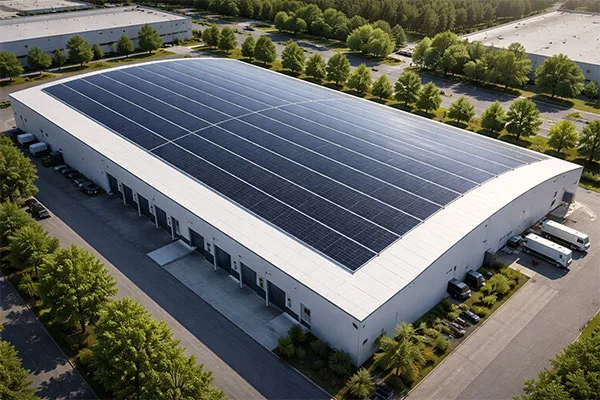
Many industrial and commercial buildings were not designed for heavy rooftop systems. In those cases, flexible BIPV can become attractive because the project may be load-limited before it is area-limited. A lighter module can open a path that a heavier system closes.
Curved or irregular surfaces
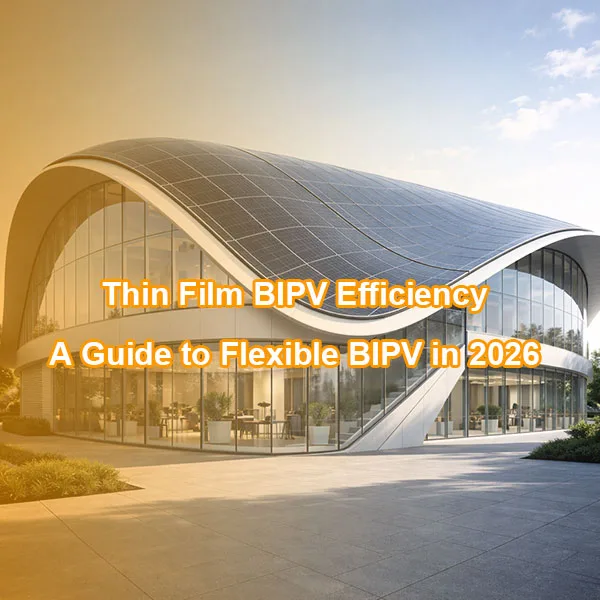
This is one of the clearest advantages of flexible formats. Standard rigid modules are best suited to flat or regularly framed surfaces. Flexible BIPV has an obvious role when the surface itself is curved, non-standard, or design-sensitive. TNO’s newly presented perovskite roof tile is a good reminder that once PV is asked to follow curved architectural geometry, installed efficiency and integration behavior become just as important as raw lab numbers.
Facades and architectural skins
For facades, the discussion often shifts away from maximum module efficiency and toward a balance of:
- appearance
- weight
- surface uniformity
- transparency or color options
- installation logic
- whole-envelope behavior
Recent public and academic content increasingly treats facades as a serious solar surface, not just a secondary one.
Semi-transparent and design-led applications
This is where perovskite BIPV gets especially interesting. DOE materials on photovoltaic windows and public commentary around perovskites emphasize exactly this mix of transparency, color neutrality, and building integration.
What Affects Thin-Film BIPV Efficiency in Real Buildings?
Surface angle and orientation
Vertical or near-vertical surfaces do not behave like optimally tilted roofs. A technology that looks weaker on a standard flat-roof comparison may still be useful on facades if the project values surface utilization and building integration enough. Recent city-scale research shows that facade solar potential is large enough to matter strategically.
Temperature and operating conditions
Real buildings do not operate at laboratory conditions. Operating temperature, partial shading, and installation method affect energy yield. NREL research on tandem devices highlights how real-world conditions such as spectrum and temperature variation change performance expectations.
Curvature and installation form
The TNO perovskite roof tile example is important because it shows a gap between standalone module efficiency and curved installed efficiency. That is not a failure. It is a reminder that building integration changes performance conditions.
Encapsulation and durability design
Thin-film and flexible formats live or die by the package, not just the absorber. Research on flexible perovskites and elastic perovskites makes this point clearly: mechanical reliability, electrode integrity, barrier protection, and fracture behavior all matter.
Building-system tradeoffs
Sometimes a slightly lower-efficiency solution wins because it simplifies waterproofing, reduces mounting complexity, or avoids structural upgrades. I think this is a more useful way to discuss efficiency in BIPV than simply repeating headline percentages.
Can Flexible Thin-Film BIPV Challenge Crystalline Silicon?
This needs a careful answer.
In mainstream commercial dominance, not yet
Crystalline silicon still leads on mature manufacturing, supply chain scale, long-term field confidence, and bankability. That is why it remains dominant in most standard solar deployment. The broader PV market and technical guidance still reflect silicon’s maturity advantage.
In selected BIPV subcategories, yes, potentially
This is the more interesting part.
Flexible thin-film and especially perovskite-based BIPV can challenge silicon where the value proposition is not purely “highest module efficiency on a flat rack,” but instead:
- lightweight integration
- curved geometry
- facade use
- semi-transparency
- color tuning
- roll-to-roll or low-temperature manufacturing potential
- surfaces where rigid crystalline modules are a poor fit
That is already visible in the direction of current research and prototype development.
In lab efficiency, the challenge is real
At the research-cell level, perovskites and especially perovskite tandems are now extremely competitive. NREL/NLR charts show perovskite single-junction cells and perovskite tandem cells at the front edge of research efficiency progress, and recent public reporting notes flexible perovskite-silicon tandem results above 33%.
In commercial BIPV products, the challenge is still emerging
In commercial BIPV products, the challenge is still emerging
A 33%+ flexible tandem research result is not the same thing as a mature, bankable, building-integrated product family. Early products such as perovskite roof tiles are exciting, but they are still early indicators, not proof that silicon will soon lose its dominant place across all building applications.
The more balanced judgment is this: flexible thin-film and perovskite BIPV are credible challengers in specific architectural and lightweight BIPV niches, but they are not yet in a position to displace crystalline silicon broadly across the mainstream market.
What Are the Common Mistakes When Evaluating Thin-Film BIPV?
Common mistake 1: treating lab efficiency as project efficiency
A research record is valuable, but a building project depends on:
- lamination
- encapsulation
- encapsulation
- weather exposure
- replacement strategy
- maintenance reality
That is why product-stage and system-stage evidence matter more than lab headlines alone.
Common mistake 2: assuming flexible means durable
Flexible means the format can adapt. It does not automatically mean the device will remain stable under repeated thermal and mechanical stress. Research on flexible perovskites shows that mechanical failure remains a central challenge.
Common mistake 3: comparing only watts per square meter
That matters, but it is not enough. In BIPV, you also need to compare:
- weight per square meter
- waterproofing burden
- structural implications
- visual integration
- installation complexity
- what building material is being replaced
More importantly, that is often where thin-film formats recover ground that they lose on raw efficiency.
Common mistake 4: using thin-film BIPV where standard silicon already solves the problem
In most cases, if the building has a strong roof, simple geometry, and no integration pressure, crystalline silicon remains the safer and more economical choice. The most intelligent use of thin-film BIPV is not everywhere. It is where its format advantage is real.
Choose conventional crystalline silicon first when:
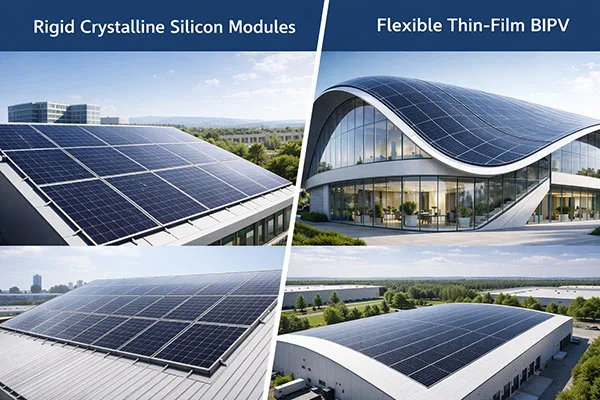
Choose conventional crystalline silicon first when:
- the roof is flat and structurally capable
- maximum mainstream efficiency matters most
- the project wants the most mature supply chain
- the project wants the most mature supply chain
Choose thin-film or flexible BIPV more seriously when:
- roof load is limited
- the surface is curved or irregular
- the project is facade-led
- semi-transparency or architectural appearance matters
- the PV layer can replace another building material
- the project can accept emerging-technology tradeoffs for better integration
For me, that is the clearest way to frame the decision. This is not a winner-takes-all contest. It is a fit-for-application decision.