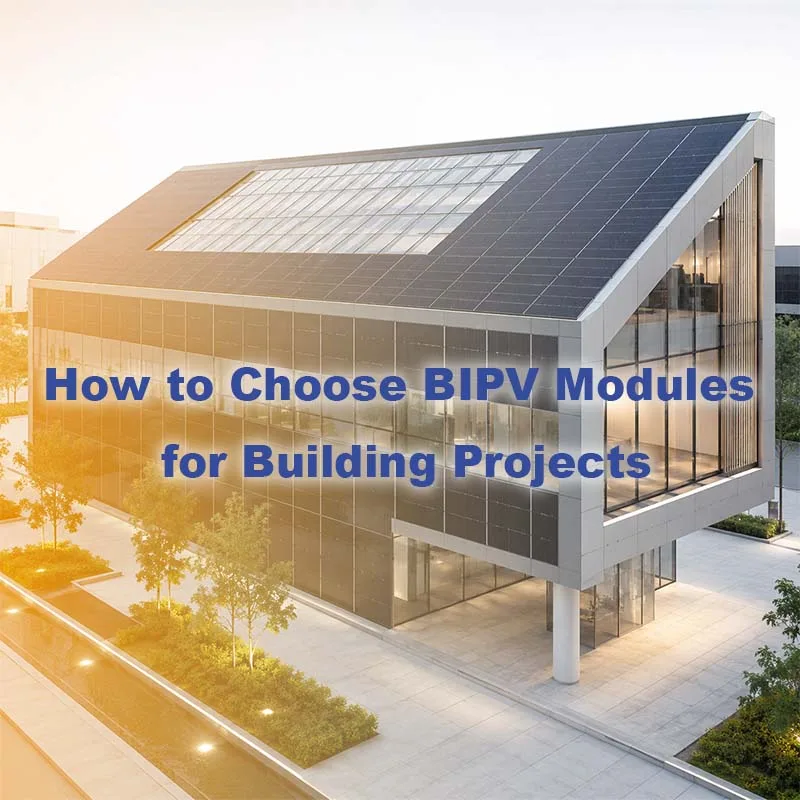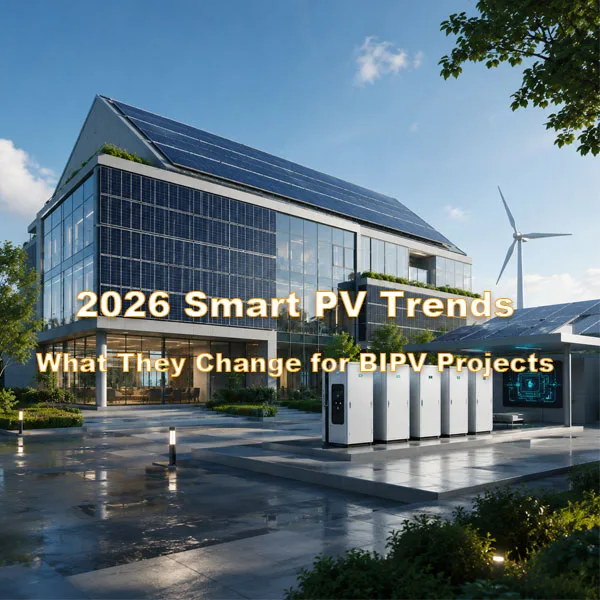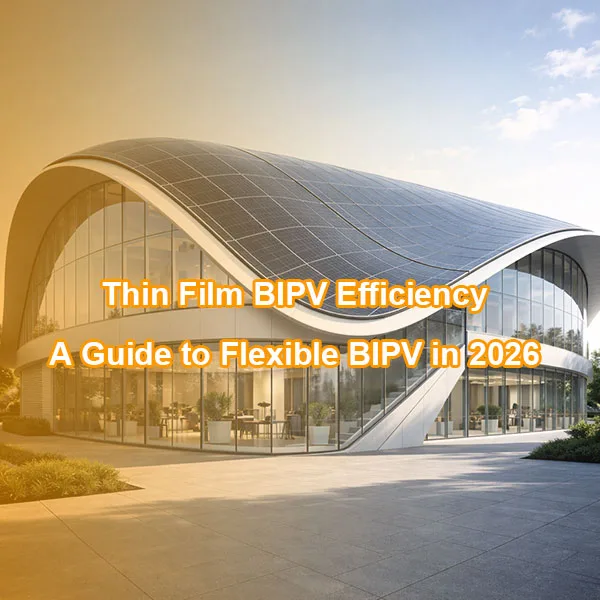
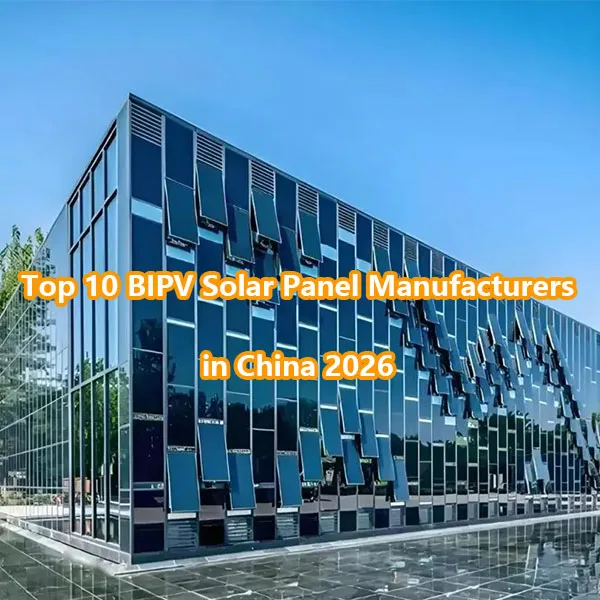
Building-Integrated Photovoltaics (BIPV) is a technology that replaces conventional building materials — roofs, facades, curtain walls, and glazing — with photovoltaic elements that simultaneously generate clean electricity and serve a structural or architectural function. Unlike rack-mounted solar panels bolted onto a finished building, BIPV is the building skin itself. And in 2026, China stands at the center of this revolution, supplying the world’s most advanced, cost-competitive BIPV modules and integrated systems.
If you’re an architect, EPC contractor, real estate developer, or procurement manager trying to figure out who the serious players are — this guide is written for you.
Table of Contents
Why China Leads the Global BIPV Market
I’ve spent years working across BIPV projects in Europe, Southeast Asia, and the Middle East. One question comes up in almost every procurement conversation: “Should we source from China?” The short answer is yes — and the data backs it up clearly.
The global BIPV market was estimated at USD 23.67 billion in 2023 and is projected to reach USD 89.8 billion by 2030, growing at a CAGR of 21.2%. Within that trajectory, China isn’t just a participant — it’s the manufacturing engine. In 2021, China produced approximately 80% of global polysilicon, 95% of wafers, 80% of cells, and 70% of modules. That upstream dominance translates directly into BIPV: the best glass-glass laminates, the most competitive custom solar facades, and the deepest engineering bench are all predominantly Chinese.
The global BIPV market is projected to grow from USD 28.33 billion in 2026 to USD 85.9 billion by 2034, at a CAGR of 14.87%. Meanwhile, Asia Pacific is the second-largest BIPV market, estimated to hit USD 8.57 billion in 2026, recording a CAGR of 18.76% through the forecast period.
For project teams evaluating suppliers, this context matters. You’re not just buying panels from a low-cost country — you’re tapping into the most vertically integrated, R&D-active solar manufacturing ecosystem on the planet.
How I Evaluated BIPV manufacturer
This isn’t a paid ranking. Here’s the lens I used to assess each company:
BIPV-specific product depth (not just standard modules adapted for building use)
Customization capability (color, transparency, geometry, cell technology)
Engineering & integration support (BIM compatibility, structural load data, waterproofing systems)
International project track record (proven deployments beyond domestic China)
Certifications (IEC, CE, fire ratings, building code compliance in target markets)
Supply chain reliability and lead time
Top 10 Solar Panel BIPV manufacturer in China for 2026
1. LONGi Green Energy Technology Co., Ltd.
Founded: 2000 | HQ: Xi’an, Shaanxi | Website: longi.com
LONGi is the undisputed global leader in monocrystalline silicon, and its BIPV division is one of the most technically mature in the industry. LONGi has developed dedicated BIPV product lines including “LONGroof” and “LONGtile,” designed for industrial rooftops and architectural façades, delivering high energy output while serving as integral parts of the building’s outer structure with waterproofing, load-bearing, and thermal performance.
LONGi’s Hi-MO 9, launched in 2025, achieves 660W power output and 24.43% efficiency, surpassing TOPCon modules by over 30W. For BIPV applications, this efficiency density matters enormously — every square meter of facade or roof has to earn its keep.
Best for: Large-scale industrial and commercial BIPV rooftops, vertically integrated supply chain projects.
Certification highlights: Top Performer recognition (PVEL), ISO 20400, IEC-certified modules.
2. Trina Solar (TrinaBIPV)
Founded: 1997 | HQ: Changzhou, Jiangsu | Website: trinasolar.com
Trina Solar has taken BIPV seriously enough to build a dedicated product line around it — TrinaBIPV. Through its TrinaBIPV line, Trina Solar delivers BIPV systems for industrial parks, warehouses, and public buildings, designed not just for power generation but also for safety (fire, lightning), insulation, and smart integration.
Trina Solar leads in BIPV solar innovation — solar tiles for roofs, industrial walls, PV noise barriers, and colored PV glass — with products reaching up to 21.9% efficiency. Trina Solar has won awards for new ideas and appears on Forbes China’s top 50 list of innovative companies.
What I appreciate about Trina’s approach is the multi-performance design philosophy. Their BIPV elements are engineered to meet building code requirements — fire class, structural load, thermal insulation — not just power output specs. That matters when you’re dealing with building permits in Germany or the Netherlands.
Best for: Public and commercial buildings demanding BIPV with multi-function compliance (fire, insulation, smart grid).
3. Risen Energy Co., Ltd.
Founded: 1986 | HQ: Ningbo, Zhejiang | Website: risenenergy.com
Risen Energy may not always top the module shipment rankings, but in the BIPV space specifically, their breadth is genuinely impressive. Risen Energy has embraced the full potential of BIPV with a broad product portfolio that includes metal-replacement roofing, PV curtain walls, and daylighting structures. Their BIPV systems combine advanced solar technology with building functionality, making them ideal for both new construction and green retrofits.
Risen Energy’s BIPV projects span 50 countries, with over 350 completed projects and annual production capacity of 2 million square feet of BIPV panels. Their products meet ISO 14001 and ISO 9001 standards.
Three hundred and fifty completed projects across fifty countries. That’s not a brochure claim — that’s a track record you can verify with reference checks. For B2B buyers who need to justify supplier selection to a board or client, Risen Energy delivers the portfolio evidence.
Best for: International new-build and retrofit projects, curtain wall and daylighting applications.
4. JinkoSolar Holding Co., Ltd.
Founded: 2006 | HQ: Shanghai | Website: jinkosolar.com
JinkoSolar is the world’s top module manufacturer by shipment volume — Jinko Solar leads global market share at 13%, with shipments increasing from 79 GW in 2023 to 93 GW in 2024. Their BIPV entry point is primarily through high-efficiency modules (Tiger Neo series at up to 23.8% efficiency) adapted for facade and roof integration, combined with strong engineering support.
What Jinko brings to BIPV is financial stability, global logistics infrastructure, and the ability to supply at scale without lead-time disruptions. If your project is a 50,000 m² commercial campus and you need 5 MW of BIPV modules delivered in synchronized production batches — Jinko has the manufacturing depth to execute.
Best for: Large-volume commercial and industrial BIPV projects where supply security and logistics support are critical.
5. Gain Solar (Baoding Jiasheng Optoelectronics Technology Co., Ltd.)
Founded: Part of Yingli Group | HQ: Baoding, Hebei | Website: gainsolarbipv.com
Gain Solar holds a distinct position in this list — it’s a pure-play BIPV specialist born out of the Yingli Group’s deep silicon heritage. Gain Solar is a leading expert in carbon-neutral solutions, committed to providing innovative BIPV green materials such as solar tiles and solar floors, with a vision to create a world where solar energy can be harnessed from every surface the sun hits.
Their product focus on solar tiles, solar flooring, and surface-integrated PV places them firmly in the architectural-grade BIPV niche — which is exactly where projects like premium residential developments, cultural buildings, and landmark commercial structures need to source from. The design vocabulary is different here: it’s not just about watts per panel, it’s about how the material reads as architecture.
Best for: Architecturally demanding projects, premium residential, landmark public buildings.
6. BIPVSYSTEM
HQ: China | Website: bipvsystem.com
I want to be transparent here: BIPVSystem is a specialist BIPV integrator, and in my experience working with their team, what differentiates them isn’t module efficiency — it’s system-level thinking.
Most of the manufacturers above are module companies that sell into BIPV. BIPVSystem is a BIPV system solutions company that starts from the building brief and engineers backwards to the panel spec. That’s a fundamentally different value proposition.
Their BIPV modules and curtain wall products cover the full application envelope — roof-integrated systems, ventilated facade systems, semi-transparent glazing BIPV, and custom structural framing. What makes the technical conversation with BIPVSystem different is that their engineers understand both the photovoltaic side (cell technology, stringing, inverter matching) and the building envelope side (thermal bridging, waterproofing, structural fixings, fire classification).
For architects working on net-zero or LEED/BREEAM-certified buildings, this matters. You don’t want to be the project manager translating between your panel supplier and your facade subcontractor — you want one partner who owns the interface.
Their customization capability is particularly strong: custom dimensions, custom transparency levels (from opaque to ~40% visible light transmission), custom color treatments, and printed patterns using PV glass. This is not off-the-shelf solar.
If you’re at the early design stage and want to understand what’s technically and commercially feasible for your specific project, I’d recommend reaching out directly: Request a custom BIPV quote.
Best for: Architects and developers needing full system integration, custom facade and roof BIPV, projects requiring engineering-led design support.
7. Chint New Energy (Astronergy)
Founded (Chint Group): 1984 | HQ: Hangzhou, Zhejiang | Website: astronergy.com
Astronergy, the PV arm of the CHINT Group, brings a smart energy systems perspective to BIPV. As part of the Chint Group, Chint New Energy blends solar generation with building automation. Its BIPV offerings are widely used in smart campuses, solar rooftops, and integrated solar parking canopies, providing energy savings and grid-responsive performance.
The CHINT Group’s broader expertise in low-voltage electrical systems, energy management, and EMS platforms means that Astronergy’s BIPV doesn’t stop at the panel. Their integrated approach — combining PV generation, storage, and smart energy management — is particularly relevant for campus-scale projects and industrial parks with complex energy demand profiles.
Astronergy recorded a 43% annual shipment increase between 2023 and 2024, demonstrating fast-growing manufacturing scale and market momentum.
Best for: Smart campus, industrial park, and EMS-integrated BIPV projects.
8. CNBM (China National Building Material Group)
Founded: 1984 | HQ: Beijing | Website: cnbm.com.cn
There’s a category of BIPV project where the glass is the building — monumental atriums, full-height structural glazing, landmark public facades where you need PV glass that a structural engineer and a glazing contractor can both sign off on without hesitation. That’s where CNBM stands apart from everyone else on this list.
As a state-owned enterprise and one of the world’s largest building materials conglomerates, CNBM has something rare in the BIPV space: genuine vertical control over the glass value chain. They manufacture TCO-coated glass (the transparent conductive substrate that makes PV glass work), laminated safety PV glass, and complete integrated facade systems — all under one institutional roof. CNBM’s BIPV projects consistently feature large-scale skylights, atriums, and PV façades, precisely because their material science capabilities let them engineer glass that simultaneously meets structural, fire, acoustic, and photovoltaic performance requirements.
For a typical BIPV supplier, that kind of multi-performance glass is sourced from a third-party glass processor. For CNBM, it’s in-house. That distinction matters when you’re specifying a 3,000 m² PV atrium roof for an airport terminal or a civic cultural center — projects where the consequence of a glass failure is not just an energy shortfall but a structural and safety incident.
Best for: Monumental public buildings, large-scale PV glazing and atrium structures, projects demanding vertically integrated glass supply with full structural and safety certification.
9. Suntech Power
Founded: 2001 | HQ: Wuxi, Jiangsu | Website: suntech-power.com
Suntech holds a historic place in global solar — it was one of the first Chinese manufacturers to achieve genuine international brand recognition. Their BIPV heritage is real: Suntech is known for their technological innovations in solar energy, particularly in building-integrated photovoltaics (BIPV) and high-efficiency modules, serving markets in over 100 countries with significant presence in Europe, the US, Asia, and Australia.
For buyers in markets where brand familiarity and long-term service track record matter — particularly European commercial projects where building warranty chains are taken seriously — Suntech’s established presence provides reassurance. Their modules are physically robust, and the company has navigated significant industry cycles, which speaks to institutional resilience.
Best for: European and international commercial projects valuing long-established brand and warranty support.
10. Tengying New Energy (Shenzhen Tengying)
HQ: Shenzhen, Guangdong
Tengying rounds out this list as a strong specialized BIPV player focused on architectural diversity. Tengying New Energy gives you many ways to use BIPV solar — facades, roofs, windows, canopies, or shading devices. Their PV cladding and curtain walls fit into building design. They also offer solar shingles, PV windows, and solar carports.
What I find useful about Tengying is their focus on the full taxonomy of BIPV applications. Many manufacturers are strong in one application type (e.g., roofs) but shallow in others. Tengying’s breadth across facades, windows, shading, and carport canopies makes them a viable partner for mixed-use developments where different building zones require different BIPV typologies.
Best for: Mixed-use developments, multi-application BIPV projects, shading-integrated solar.
Quick Comparison Reference
| Manufacturer | BIPV Specialty | Best Application |
|---|---|---|
| LONGi Green Energy | Industrial rooftop, LONGroof/LONGtile | Large-scale rooftop |
| Trina Solar (TrinaBIPV) | Multi-function BIPV, colored glass | Public & commercial buildings |
| Risen Energy | Curtain wall, daylighting, retrofit | International new-build & retrofit |
| JinkoSolar | High-volume supply, Tiger Neo efficiency | Large-volume commercial |
| Gain Solar | Solar tiles, architectural BIPV | Premium & landmark projects |
| BIPVSYSTEN | Full system integration, custom facades | Architects & developers, custom projects |
| Chint New Energy | Smart campus, EMS integration | Smart building campuses |
| CNBM | PV glazing, vertically integrated glass chain | Monumental public & infrastructure buildings |
| Suntech Power | International brand, warranty track record | European commercial |
| Tengying New Energy | Multi-typology BIPV | Mixed-use developments |
What to Ask Any BIPV Manufacturer Before You Sign
Before you send an RFQ to any supplier on this list, here are the questions that separate a serious BIPV partner from a panel company repurposing standard modules:
On product: Does this module have a fire classification rating (EN 13501, UL 790) appropriate for facade or roof use in my target market? What’s the maximum custom dimension you can produce? Can you provide structural load certification data in a format my structural engineer can use?
On the system: Who is responsible for waterproofing at the panel-to-structure interface? Do you provide drainage calculations? Can you supply BIM/CAD files for your fixing system?
On the project: Can you provide reference contacts from three completed projects of comparable scale and typology? What is your standard warranty structure for both the PV element and the building envelope function?
The answers to these questions will tell you more about a manufacturer’s genuine BIPV capability than any brochure or ranked list.
Understanding What BIPV Actually Means for Your Project
One thing I want to flag clearly: not all products marketed as “BIPV” are equivalent. There’s a meaningful technical distinction between:
BIPV — the photovoltaic element replaces a conventional building material (e.g., a solar glass curtain wall replaces glazing units)
BAPV (Building-Applied Photovoltaics) — solar panels added onto an existing building envelope without replacing it
True BIPV carries higher upfront cost but delivers dual value: energy generation plus building envelope function (weatherproofing, thermal insulation, structural contribution). The net cost delta, when you credit the avoided cost of conventional materials, is often smaller than first-pass estimates suggest.
For green building certification pathways (LEED v4, BREEAM, DGNB), the distinction between BIPV and BAPV can also affect which credits apply. Work with your BIPV supplier and energy consultant together early in the design phase — it’s much harder to retrofit the commercial case after the building design is frozen.
FAQ: People Also Ask About BIPV Manufacturers in China
What is the best BIPV manufacturer in China for 2026?
How is BIPV different from regular solar panels?
Are Chinese BIPV manufacturers certified for international markets?
What is the typical efficiency range of BIPV modules from Chinese manufacturers?
How do I get a custom BIPV facade system from a Chinese manufacturer?
What is the market outlook for BIPV in 2026 and beyond?
What building types benefit most from BIPV systems?
How long does a BIPV system last?
For project-specific technical consultation or to explore custom BIPV options for your next building, visit bipvsystem.com or get in touch with the BIPVSystem team.