BIPV news in 2025 highlights a historic pivot where Building-Integrated Photovoltaics transitioned from niche architectural aesthetics to a standardized powerhouse of energy production, driven by record-breaking perovskite-silicon tandem cell efficiencies exceeding 33.9%.
This past year, BIPV news was defined by the intersection of high-performance materials and aggressive global legislation, such as the European Union’s Energy Performance of Buildings Directive (EPBD), which now mandates that new structures move toward zero-emission status by integrating renewable energy directly into the building envelope. As we look back, 2025 was the year the building skin finally became an active, profit-generating asset for developers and architects alike, marking a definitive end to the era of “passive” construction materials.
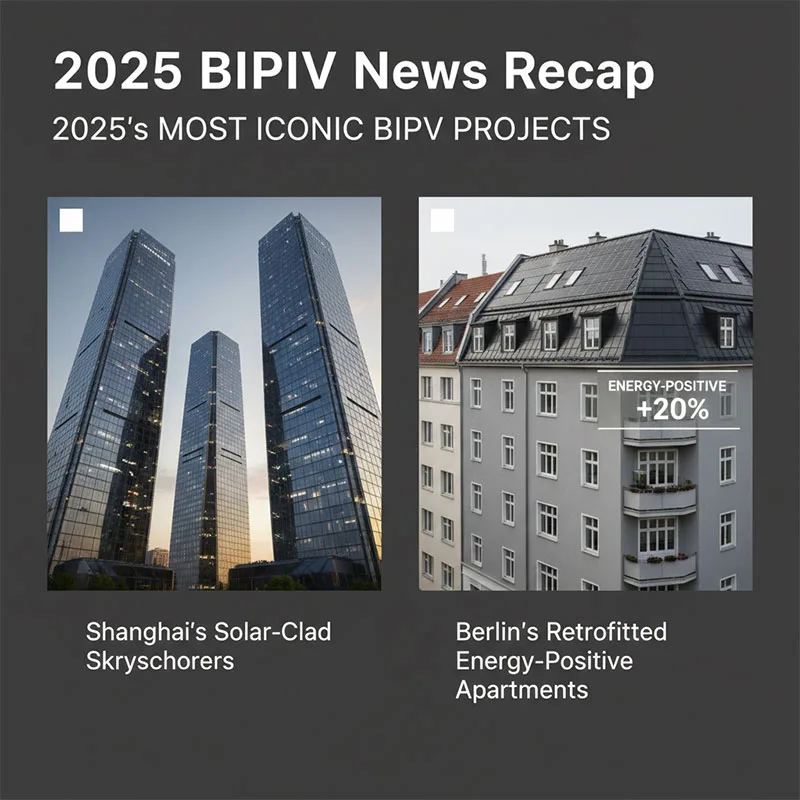
As a technical expert who has spent years on the factory floor and in design consultations, I can tell you: 2025 didn’t just feel like another year—it felt like a liberation. For a decade, the pain point for every developer has been the “beauty vs. power” trade-off. We used to struggle to convince architects that solar glass wouldn’t ruin their vision. In 2025, the news cycle finally shifted from “Can it work?” to “How fast can we scale it?”
Recommended authoritative reading: For a government-backed overview of what BIPV is (and where it integrates in roofs/facades/canopies), see the U.S. DOE’s Whole Building Design Guide (WBDG) BIPV resource.
Table of Contents
The 2025 BIPV News timeline that mattered
1. BIPV News: Policy & market frameworks got more “project-ready” (especially in the U.S.)
For many developers, 2025 wasn’t about a single BIPV law—it was about clean-electricity credit rules becoming clearer, which shapes how building-integrated solar gets financed and sourced.
The U.S. issued final regulations for the technology-neutral clean electricity credits (45Y and 48E) in January 2025 (published in the Federal Register).
The IRS also published guidance explaining how the domestic content bonus works (relevant for projects optimizing supply chain and compliance documentation).
Why it matters for BIPV: once incentives and eligibility rules harden, projects start demanding better documentation—product data, test evidence, bill of materials, and predictable installation methods. That’s where BIPV suppliers either level up… or get filtered out.
2. BIPV News: Standards and “how to design it” got a boost
In 2025, the most useful “news” wasn’t a flashy product—it was the quiet shift toward shared technical language.
The IEA PVPS community continued publishing BIPV-focused work (Task 15), including a country innovation ecosystem analysis (March 2025) and a clear agenda for 2025 workstreams.
A major technical reference released in 2025 is the Building-Integrated Photovoltaics: A Technical Guidebook—it explicitly ties BIPV to building detailing and references the IEC 63092 definition and requirements framing.
My factory-side take (a little human moment): the first time I had to review a facade-BIPV package years ago, I was surprised how often teams had perfect electrical diagrams… and almost no envelope detailing. In 2025, more guidance finally connects those two worlds—the part that makes projects succeed.
3. BIPV News: 2025’s “technology breakthrough” story: transparent + flexible PV moved closer to buildings
A big theme in 2025 was PV formats that match architecture: transparent glazing PV, ultra-thin flexible PV films, and materials better suited to dense cities.
Transparent organic PV facade / windows: Next Energy Technologies completed a first installation of a transparent OPV glass façade, covered by PV media in July 2025.
Flexible perovskite solar films for urban surfaces: A notable 2025 coverage thread highlighted government-backed investment and commercialization plans for ultra-thin perovskite PV aimed at constrained urban applications.
Research consolidation: 2025 review literature increasingly treats BIPV as a multi-level design problem (cell → module → electrical → building), reinforcing that progress isn’t just efficiency—it’s integration.
What to watch: transparent/flexible PV is exciting, but the adoption gate is still durability, certification pathways, and long-term performance data—especially when the PV is literally part of the weather barrier.
4. BIPV News: Residential solar shingles: meaningful product iterations
If you track “bipv news” because homeowners keep asking for “solar that doesn’t look like solar,” 2025 had clear movement.
GAF Energy launched Timberline Solar ES 2 in February 2025, positioning it as an upgraded “nailable solar shingle” platform; PV trade coverage also highlighted power-per-shingle updates.
Mainstream media continued to stress the market truth: solar roofs are attractive, but often more expensive and still niche, making “roof replacement timing” a key decision lever.
My honest take: I love where residential BIPV is heading, but buyers hate two things:
unclear maintenance paths (“if one section fails, do I open the whole roof?”)
fuzzy economics (“am I comparing this to PV, or to a new roof + PV?”)
5. BIPV News: More “iconic” BIPV projects used architecture as marketing
Even when press releases feel glossy, they serve a purpose: they normalize BIPV as a building material.
Mitrex announced a Guinness World Record tied to a BIPV solar mural project (July 2025). Treat it as a branding story—but it still signals growing acceptance of BIPV as facade cladding.
Architectural media also increasingly mentions BIPV as part of the high-performance façade conversation (late-2025 coverage roundups reflect this mainstreaming trend).
6. BIPV News: Market outlook headlines kept shouting “growth,” but practitioners stayed cautious
In 2025, market research releases continued projecting strong BIPV growth (often double-digit CAGR). These are helpful for investor mood, but they’re not the same as project bankability.
Example: BCC Research-linked release projected growth from 2024 to 2029 in the BIPV market.
Meanwhile, peer-reviewed and institutional sources repeatedly emphasize: BIPV is still a niche market in many regions, mainly because the “dual nature” (PV + building product) makes adoption harder.
Translation: 2025 was optimistic—but the winners will be the suppliers who can prove reliability, provide documentation, and integrate smoothly into building workflows.
Start with the envelope decision: Is BIPV replacing roof/facade materials or being added on?
Demand “building + PV” documentation: drawings, test evidence, installation method statements, maintenance access strategy.
Separate innovation from procurement risk: transparent/flexible PV is promising, but choose where you can tolerate uncertainty (pilot vs core facade).
For residential BIPV: price it against new roof + conventional PV, not PV alone.
What this means for buyers going into 2026 (the practical checklist)
If you’re using 2025 news to plan 2026 projects, here’s what I’d focus on:
FAQ
What was the most significant BIPV news in 2025?
The most significant news was the commercialization of perovskite-silicon tandem cells, which pushed efficiency records past 34% (certified by NREL). Additionally, the implementation of the EU’s EPBD directive made BIPV a central strategy for mandatory net-zero building targets.
Is BIPV more efficient in 2025 than it was in previous years?
Yes. Breakthroughs in tandem cell technology and bifacial glass interlayers have increased typical BIPV module efficiency by nearly 20% compared to 2022 standards, allowing facades to generate meaningful power even in diffuse light conditions.
How did global policy affect the BIPV market in 2025?
Policies like the U.S. Inflation Reduction Act (IRA) “Domestic Content Bonus” and the EU’s EPBD mandates forced the construction industry to adopt BIPV as a standardized building material. This led to a record global market size, with some estimates exceeding $20 billion by the end of 2025.
At BIPVSystem, we lived through every one of these headlines. We spent 2025 retooling our lines to support the new tandem cell standards and helping our clients navigate the maze of new green building laws. We don’t just follow the news; we build the products that make the news.
Would you like a copy of our “2026 Technical Roadmap” based on these 2025 breakthroughs? Let’s ensure your next project stays ahead of the curve.