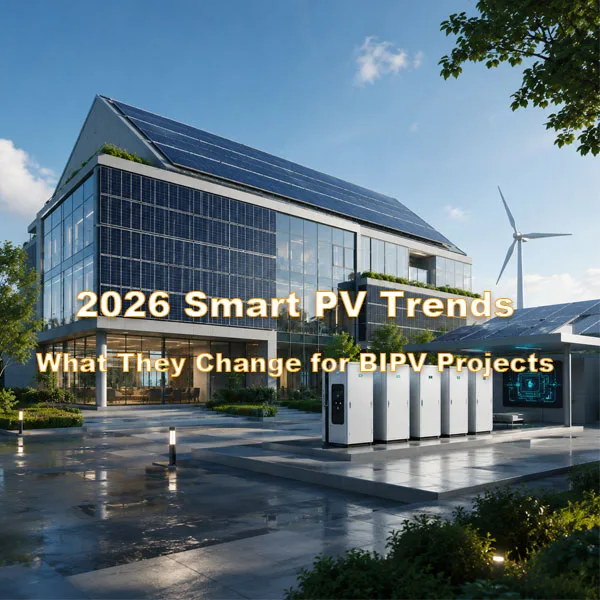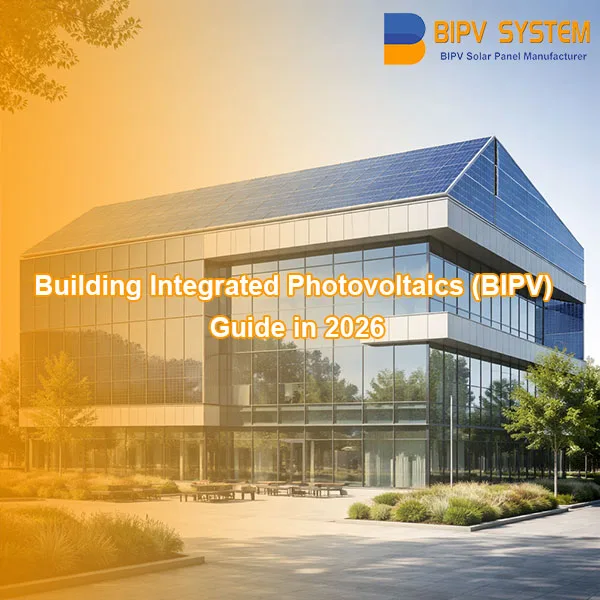

Analysts project that the bipv market will continue its rapid global expansion through 2026 and beyond, driven by sustainable construction trends, net-zero energy building targets, regulatory support, and technological improvements.
Driven by favorable government subsidies, falling technology costs, and the “Net-Zero” building movement, this market is no longer a niche architectural experiment but a mainstream financial strategy for developers worldwide seeking sustainable, energy-independent assets.
The global BIPV market refers to the building-integrated photovoltaics sector, where solar energy systems are embedded directly into architectural elements of buildings—such as roofs, facades, and windows—allowing structures to generate their own electricity while serving as functional building materials.
After exploring the key global growth drivers and forecasts, you can also dive into our BIPV Blog & Resources for deeper expert guides on industry trends and BIPV applications.
Table of Contents
Global BIPV Market Size & Forecast to 2026
According to multiple industry sources, the global building-integrated photovoltaics market is poised for strong growth:
Some market analysts estimate the BIPV market will grow from around USD 23–27 billion in the mid-2020s to significantly higher levels by the end of the decade, showing robust adoption in commercial, residential, and industrial buildings.
One projection suggests the market value could rise from about USD 32.6 billion in 2026 to well over USD 164 billion by 2035, with average annual growth rates near 19–20%.
Industry analysts predict that the global bipv market will grow at a Compound Annual Growth Rate (CAGR) of over 15-20% through 2026. While the numbers vary slightly between sources like Grand View Research and Fortune Business Insights, the consensus is that we are looking at a market value exceeding $30 billion within the next few years.
Why the sudden jump? It’s the “Snowball Effect.” As more landmark projects (like the Apple Park or Google’s Bay View campus) prove that BIPV works at scale, the perceived risk for smaller developers vanishes.
Key Growth Drivers: What’s Pushing the bipv global Trend?
Key Growth Drivers in the BIPV Market
1. Sustainable Building Regulations and Net-Zero Targets
Governments worldwide are tightening building codes and net-zero energy mandates, which directly support BIPV adoption in green buildings. Incentives such as tax credits, feed-in tariffs, and subsidies are helping developers offset costs associated with integrated solar systems.
In the EU, the Energy Performance of Buildings Directive (EPBD) is a massive “stick,” mandating zero-emission buildings. Meanwhile, the “carrot” comes in the form of tax credits (like the ITC in the United States), which significantly lower the upfront cost of bipv global installations.
2. Rising Renewable Energy Demand
Increasing energy consumption, carbon emission targets, and a global push toward renewable energy generation are major motivators for deploying BIPV systems. BIPV installations help buildings become decentralized energy producers, reducing dependence on external electricity sources.
Large corporations are under immense pressure from shareholders to reach Net-Zero. A building with a BIPV facade isn’t just a workspace; it’s a giant, visible billboard that says, “We are serious about the planet.”
3. Technological Advancements
Innovation in photovoltaic materials—including thinner, more efficient modules and architectural integration options—has expanded the design and application scope of BIPV systems. This trend is enabling greater adoption in both new construction and retrofit projects.
Improvements in PV materials and integration techniques—learn more about how these systems function at a technical level in our How BIPV Works article.
Regional Market Dynamics
Europe remains a significant market due to stringent energy efficiency standards and supportive policies promoting green construction.—Research Nester
Asia Pacific, especially China and Japan, is experiencing rapid growth in BIPV deployment given urbanization trends and strong renewable targets.—Grand View Research
North America shows accelerating adoption driven by sustainability goals and investment in net-zero building initiatives.
Whenever I talk to our partners in these regions, I feel a sense of urgency. They aren’t just building for today; they are building for a 2050 reality where a building without its own power source will be considered “obsolete.”
Challenges Facing the BIPV Market
Despite strong growth prospects, the BIPV market must contend with:
- High initial installation costs relative to standard solar panels
- Complex integration requirements with architectural and structural design
- Regulatory and compliance barriers in certain regions
Addressing these challenges through better cost modeling, standardized integration practices, and supportive policy frameworks will be necessary to sustain long-term market expansion.
BIPV Market Trends to Watch
- Increasing use of transparent and flexible BIPV modules
- Growth of architectural integration in commercial high-rise buildings
- Expansion of retrofit BIPV solutions for existing structures
- Rising investments in smart city and energy efficient infrastructure projects
Frequently Asked Questions (People Also Ask)
What is the global BIPV market?
The global BIPV market refers to the worldwide industry of building-integrated photovoltaics, where solar energy systems are integrated into building components to serve both architectural and energy-producing functions.
What is the current state of the global BIPV market?
BIPV market is currently in a high-growth phase, transitioning from niche architectural projects to mainstream commercial and industrial applications. This growth is driven by falling costs of solar technology and increasing global mandates for Net-Zero Energy Buildings (NZEB).
How big is the BIPV market forecast for 2026?
Industry estimates suggest the market size could reach more than USD 30 billion globally by 2026, with strong growth trends continuing into the 2030s.
What are major drivers of BIPV market growth?
Key growth drivers include global sustainability goals, government policies promoting renewables, technological advancements, and increasing construction of green buildings.
Which regions are leading BIPV adoption?
Europe, Asia Pacific, and North America are among the leading regions driving global BIPV adoption due to strong regulatory support and renewable energy commitments.
Summarize
At BIPVSystem, we’ve been tracking these trends for years, not just as observers, but as active participants. We’ve seen the technology evolve from expensive prototypes to the cost-effective, high-performance systems we offer today.
The market is moving fast. The question for developers in 2026 won’t be “Should we use BIPV?” but “Why didn’t we use it sooner?”
Are you looking for a detailed market feasibility study for your next project? Let our team help you navigate the numbers and the technology.