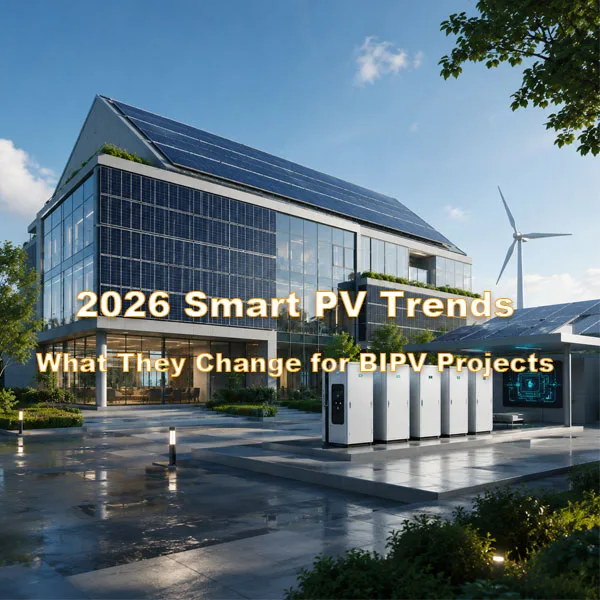
Smart PV in 2026 is PV designed as a controllable energy system—PV, storage, grid interaction, and software control working together so output becomes more predictable, safer to operate, and easier to manage. For BIPV projects, that shift is not optional. BIPV sits inside the building envelope. Once it is installed, every design mistake becomes expensive: access, maintenance, documentation, and safety can’t be “fixed later” without touching the façade or roof. Your attached white paper lays out this direction clearly through ten system-level trends across PV + storage + AI + safety.
I’m writing this as BIPVSYSTEM—meaning from the manufacturing and project-support side. We see the same pattern across regions: teams focus on modules and aesthetics early, then discover late that they never defined operating mode, monitoring deliverables, safety evidence, or long-term replacement paths. The result is rework, slow approvals, and uncomfortable handovers. The trends in the paper point to a simple conclusion: BIPV projects must be specified and delivered like long-life infrastructure, not like “solar added to architecture.”
Featured Snippet target answer
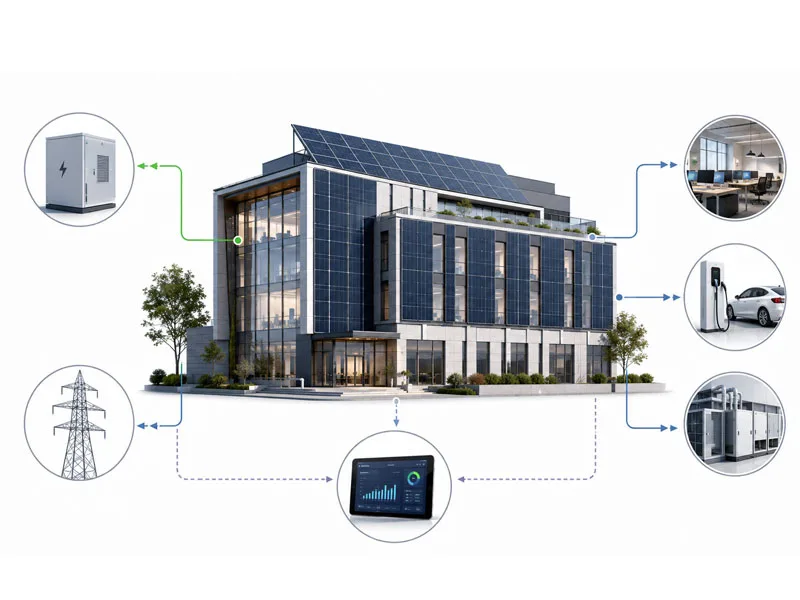
In 2026, the best BIPV projects are designed as PV + storage systems with clear control, monitoring, and safety evidence. That approach improves predictability, reduces operational risk, supports stricter grid requirements, and makes long-term O&M realistic—especially when PV is part of the building envelope.
Table of Contents
Why green building targets increasingly “pull” BIPV into the conversation
This is the uncomfortable truth: the building sector is big enough that small optimizations won’t get us there.
- The GlobalABC/UNEP Global Status Report notes that in 2022, buildings were responsible for 34% of global energy demand and 37% of energy and process-related CO₂ emissions.
- The IEA similarly highlights that building operations account for about 30% of global final energy consumption and 26% of global energy-related emissions (split across direct and indirect).
- The IPCC AR6 (WGIII) discusses the split between operational and embodied emissions in buildings, underscoring why both matter in decarbonisation strategies.
So green building goals (LEED, BREEAM, net-zero programs, local codes) are increasingly pushing projects toward measured energy performance and renewable supply—not just “nice materials.”
What “BIPV” really means
IEA PVPS Task 15 puts it clearly: a BIPV module is both a PV module and a construction product, designed to be a component of the building; if you remove it, you must replace it with another construction product.
That definition is more than semantics. It changes who needs to be in the room:
- Architect / façade consultant: appearance, module layout, daylight, glare
- Structural engineer: wind loads, anchors, façade substructure
- MEP engineer: string design, inverters, protection, monitoring
- GC / facade contractor: tolerances, waterproofing, installation workflow
- Owner / facility team: access, cleaning, replacement strategy
If BIPV is treated as “just solar,” it tends to get value-engineered away. If it’s treated as a building system with electrical output, it survives procurement much more often.
How the “trends” translate into practical BIPV decisions
1. PV–wind–storage coordination: predictability becomes a requirement
The white paper’s first trend frames the future renewable base as PV+wind+storage working together so power is “predictable and controllable.”
For BIPV, the practical shift is that owners increasingly ask for operating behavior, not only generation.
What to do in BIPV design
- Define target operating modes early (self-consumption, export-limited, peak shaving, backup/resilience).
- Document how storage and controls will shape the building’s net load profile.
2. Grid-forming energy storage: stability services influence architecture decisions
The paper highlights grid-forming storage as a growing stability and balancing tool and describes how it can enable additional market value beyond energy shifting.
What to do in BIPV projects
- Specify protection, metering, and control interfaces so the system can support stricter grid requirements or future market participation (where applicable).
- Avoid late-stage “bolt-on” controls. Integration cost is always higher after installation.
3. Source–grid–load–storage collaboration: buildings become active energy nodes
The paper describes a move toward “regional autonomy + global collaboration,” enabled by data linkage and AI scheduling.
What to do
- Treat BIPV + ESS as part of a broader building energy strategy: flexible HVAC, coordinated EV charging, and clear load priorities.
- Require that energy flows and value streams are visible in monitoring outputs.
4. Home PV+storage becomes AI-native: user experience becomes measurable
The paper notes residential PV+storage moving from AI-enabled to AI-native, with a focus on “Optimal Return” instead of only maximizing self-consumption, and includes a community-scale example of AI energy management benefits.
What to do (residential BIPV and small C&I)
- Treat monitoring and optimization as deliverables, not add-ons.
- Define minimum monitoring granularity and alert logic in procurement specs.
5. Power density and high voltage: equipment footprint and BOS logic shift
The paper links higher power density to high-frequency electronics (including SiC trends) and describes a push toward higher voltage and reliability to reduce cost per kWh.
What to do
- Plan equipment rooms, cable routing, and thermal management early—especially in buildings where space is constrained.
- Treat BOS decisions as part of system architecture, not only procurement.
6. “Battery ≠ storage system”: system-level battery management is mandatory
The paper stresses that safe, stable storage requires management across multiple levels, not “cell-level safety” alone.
What to do
- Require system-level monitoring, fault isolation logic, and clear documentation of protection behavior.
- Ask vendors to provide a safety operating concept, not only capacity and warranty terms.
7. Safety quantification: moving beyond pass/fail
The paper explicitly calls for shifting from limited “sample testing” and partial scenario coverage to lifecycle and full-scenario safety quantification.
What to do
- Build a “safety evidence pack” into your project documentation: testing scope, traceability, monitoring thresholds, maintenance routines, and emergency response procedures.
- Make this evidence auditable—useful for approvals, insurers, and asset owners.
A BIPV-ready checklist for 2026
If your goal is to align BIPV delivery with 2026 Smart PV expectations, here are the items that consistently reduce risk:
Operating mode defined: self-consumption, export limits, peak shaving, resilience
System boundary locked: envelope + PV + storage + controls + monitoring
Data requirements specified: dashboards, alarms, fault localization, performance reporting
Safety documentation packaged: testing references, traceability, procedures, escalation paths
O&M made practical: access, replacement strategy, and maintenance schedule
This is the difference between a project that looks good at commissioning and a project that remains reliable and operable three years later.
How BIPVSYSTEM supports this kind of delivery
BIPV succeeds when the building and the energy system are designed as one delivery scope. In practice, that means project teams need:
- clear envelope integration logic,
- controllable electrical architecture,
- monitoring and documentation as deliverables,
- and an O&M plan that is feasible in a real building.
If you want to pressure-test your current concept, we can review your system boundary assumptions and produce a project-ready checklist: operating mode, control scope, safety evidence pack, and O&M requirements aligned to your application (façade, roof, glass, canopy).