If you are comparing BIPV modules vs traditional solar panels, the short answer is simple: traditional solar panels are usually the better fit when you want the lowest-cost solar system on an existing building, while BIPV modules make more sense when solar is expected to become part of the building itself. The real difference is not just technology. It is integration versus attachment. Public guidance from the U.S. Department of Energy describes BIPV as photovoltaic materials that replace conventional building materials in parts of the building envelope, while traditional PV is typically added onto an existing structure.
Before writing this guide, I reviewed 10 widely circulated public articles, guides, and research pieces around this topic. Most explain the basic distinction correctly: BIPV is integrated into roofs, facades, skylights, awnings, or other building elements, while traditional panels are mounted onto an existing roof or support structure. They also usually agree that traditional systems are easier to deploy on existing buildings, while BIPV becomes more attractive in new construction or full envelope replacement.
What many of those articles still do not discuss enough is the part that matters most in real projects: what the solar system is replacing, how the decision changes by project stage, why facade potential is often underestimated, and why buyers often compare BIPV to standard panels using the wrong cost logic. Recent research also suggests that limiting the discussion to rooftops misses a large part of BIPV’s practical opportunity, especially in dense urban environments where facades can contribute substantial solar potential.
Table of Contents
What Is the Core Concept?
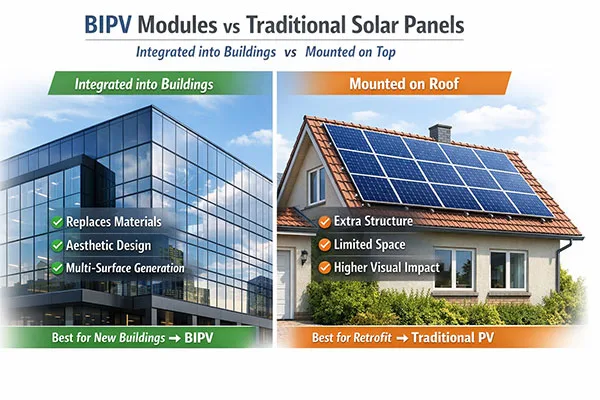
Traditional solar panels (also called BAPV—Building-Applied Photovoltaics) are mounted *onto* a building. Racks bolt to the roof or wall structure, panels sit on top, and the building material underneath stays unchanged. The system is essentially an add-on.
BIPV modules work differently. A BIPV roof panel replaces conventional roofing. BIPV façade cladding replaces standard curtain wall panels. BIPV glazing replaces architectural glass. The photovoltaic function is built into an element that the building needs regardless of whether it generates power.
That sounds simple, but it changes the decision completely.
Traditional solar panels are usually selected around:
- system cost
- energy yield
- roof condition
- installer access
- payback period
Traditional solar panels are usually selected around:
- roof or facade design
- waterproofing and weather protection
- structural attachment
- visual integration
- material replacement logic
- long-term building value
More importantly, the two options are often solving different problems. A traditional rooftop array is mainly an energy upgrade. A BIPV system can also be a roofing, cladding, canopy, or facade strategy.
How BIPV Modules Differ From Traditional Solar Panels
1. Function in the Building
Traditional solar panels are often easier to add later. If the building already exists and the roof is still in good condition, a standard PV system is usually the simpler path. Public BIPV guides repeatedly frame BIPV as more compelling in new construction or major renovation, where the envelope can be designed around the PV system from the start.
BIPV works best when the solar decision happens early enough to influence:
a solar product and a solar product
That is why BIPV decisions usually involve more stakeholders, including architects, facade consultants, structural teams, and building owners, not just solar installers.
2. Project Timing
Traditional solar panels are often easier to add later. If the building already exists and the roof is still in good condition, a standard PV system is usually the simpler path. Public BIPV guides repeatedly frame BIPV as more compelling in new construction or major renovation, where the envelope can be designed around the PV system from the start.
BIPV works best when the solar decision happens early enough to influence:
- roof or facade design
- waterproofing and weather protection
- structural attachment
- visual integration
- material replacement logic
- long-term building value
Actually, this is one of the biggest practical differences. Traditional solar can often be added after most building decisions are already made. BIPV usually cannot.
3. Cost Logic
This is where comparisons often become misleading.
In most cases, traditional solar panels will look cheaper if you compare only:
- panel price
- system cost per watt
- installation simplicity
That is true, and many public guides say exactly that.
But the more useful comparison is often not:
BIPV vs solar panels
It is:
BIPV vs conventional building material + solar panels
That is a very different equation.
If the BIPV system is replacing roofing, facade cladding, shading elements, or another material package the project already needs, part of the cost is doing double duty. The module is not only generating electricity. It is also replacing something non-productive.
I think this is where many public comparisons stay too shallow. They compare a dual-function system to a single-function system as if both were serving the same role. In real projects, they often are not.
4. Design and Appearance
BIPV usually has the advantage when visual integration matters. Public-facing BIPV guides consistently position integrated systems as the better fit for buildings where architectural consistency, facade treatment, or reduced visual intrusion matter.
Traditional solar panels can still work very well on industrial and commercial roofs, but they generally remain visibly installed equipment. BIPV is more likely to be selected when the project team wants:
- a cleaner facade
- a more unified roofline
- more controlled building aesthetics
- better fit with architect-led design goals
That said, aesthetics alone is not a strong enough reason to choose BIPV. The stronger reason is when design integration also supports the envelope strategy and the investment logic.
5. Surface Potential
Most buyers still think of solar in roof-only terms. That is understandable, but it is increasingly incomplete.
Recent research on building-integrated solar potential shows that facades can contribute a significant share of total solar opportunity. One 2025 study across 120 global cities found that facade PV potential averaged 68.2% of rooftop potential, which is a strong reminder that vertical surfaces are not just architectural decoration. Another 2025 study highlights that BIPV potential beyond rooftops remains underexplored.
The real issue is not whether facades always outperform roofs. They usually do not. The real issue is that in many urban projects, the facade is too large and too exposed to ignore.
How Does It Work in Real Projects?
Existing Industrial or Commercial Buildings
If the building already exists, the roof is still serviceable, and the owner wants the fastest path to on-site power generation, traditional solar panels are usually the safer choice. They are easier to install, easier to price, and easier for most contractors to understand. Public guides consistently point in this direction for retrofit-style projects.
In most cases, this is where traditional panels win:
- lower upfront complexity
- faster deployment
- clearer ROI calculation
- lower coordination burden
New Construction
BIPV becomes much more credible in new construction because the system can be coordinated with the building envelope from the beginning. Reviews published in 2025 and 2026 describe BIPV as a multi-level design decision that works best when it is part of the early project scope.
This is where BIPV can do real work:
- integrated roof systems
- solar facades
- skylights or glazing-based applications
- canopies and carports
- architecturally sensitive buildings
For me, this is the biggest dividing line. If you are shaping the building itself, BIPV deserves serious attention. If you are simply adding solar to a finished building, traditional panels usually remain the more practical answer.
Major Renovation or Envelope Replacement
This is often the most interesting decision zone.
When a building is already due for:
- roof replacement
- facade renovation
- curtain wall upgrade
- canopy reconstruction
BIPV starts to make much more sense, because it is no longer just “extra solar.” It can become part of the replacement budget and part of the building-performance strategy at the same time.
That is why the best BIPV projects are often not random solar upgrades. They are coordinated renovation or redevelopment projects.
What Factors Affect Selection?
1. Project Stage
This should usually be the first filter.
Traditional solar panels are usually the better fit when:
- the building already exists
- the roof is in good condition
- the owner wants speed and simplicity
- cost per watt is the main target
BIPV modules are more attractive when:
- the project is new construction
- the roof or facade is already being replaced
- architectural integration matters
- the PV element can replace a conventional material package
2. Available Building Surfaces
If the building has a large, unobstructed roof, standard solar may already solve most of the problem.
If the building has:
- limited roof area
- valuable facade exposure
- shading structures
- parking canopies
- visually important envelope surfaces
then BIPV becomes more relevant. Recent studies on facade solar potential support this broader surface strategy.
3. Budget Structure
If the project budget treats solar as a standalone energy expense, traditional panels usually look stronger.
If the project budget is evaluated as:
- envelope cost
- energy system cost
- lifecycle value
- material replacement value
then BIPV can become much more competitive.
The common mistake is assuming that “higher upfront price” automatically means “worse investment.” Sometimes it does. Sometimes it does not. It depends on what the system is replacing.
4. Technical Risk
DOE’s BIPV summary points out that reliability, durability, and safety must match expectations from both the building industry and the solar industry. That is a crucial point. BIPV has to perform as an envelope solution and as a power-generating system.
So the selection should include:
- waterproofing strategy
- wind-load behavior
- fire and safety context
- maintenance access
- attachment and detailing logic
- replacement and serviceability
The most important thing here is that BIPV should be evaluated like a building system, not only like a module.
Where Each Technology Actually Fits
Rather than declaring one option universally better, the more honest framing is that each technology is well-suited to specific project types.
Traditional solar panels work best when:
- Adding solar to an existing building with available roof space
- The primary objective is maximum energy yield at minimum capital cost
- The building envelope is already complete or doesn't require replacement
- Aesthetics are not a key project requirement
- The procurement timeline is short or the project is cost-constrained
BIPV modules make more sense when:
- The project is new construction or involves major envelope renovation
- The facade or roofing materials need to be specified and installed regardless
- Architectural appearance, planning compliance, or LEED/green building certification is a project requirement
- The building involves high-rise façades where fire performance requirements apply
- The site has limited roof area but significant façade surface
- The developer or owner wants to differentiate the building with integrated sustainability credentials
For industrial and factory projects specifically, BIPV roofing deserves more attention than it typically receives. Large industrial buildings often have extensive, relatively simple roof surfaces that need re-roofing every 20–30 years. Specifying BIPV roofing panels during a planned re-roofing project can reduce the net cost premium significantly while generating substantial on-site power—directly reducing grid energy costs for energy-intensive manufacturing operations.
What Are the Common Mistakes?
Treating the BIPV decision as a solar procurement decision, rather than an envelope design decision, tends to create timeline problems. As noted above, BIPV integration requires early design coordination. Approaching it like a product purchase late in the construction process almost always results in a worse outcome.
Mistake 1: Comparing Only Panel Price
This is probably the most common mistake. Traditional panels almost always look stronger if the comparison is only module cost or installed cost per watt. But that ignores whether the BIPV product is replacing part of the roof or facade package the project had to buy anyway.
Mistake 2: Choosing BIPV Too Late
BIPV usually works best when it is introduced early enough to influence the building design. If it is added after the envelope is already fixed, the project often becomes awkward, expensive, or compromised. Public reviews consistently position BIPV as strongest in new-build and major-renovation contexts.
Mistake 3: Treating BIPV as an Appearance Upgrade Only
A cleaner look is helpful, but it is not enough on its own. The stronger reasons to choose BIPV are:
- integration
- material replacement
- surface utilization
- long-term building value
Aesthetic improvement is usually a bonus, not the full business case.
Mistake 4: Thinking Only About Roofs
A lot of public content still frames solar choices as roof-only decisions. The newer research does not support that narrow view. Facades can represent a large and still underused part of building-integrated solar potential.
Mistake 5: Ignoring Who Actually Owns the Decision
Developers, architects, design institutes, industrial owners, and green-building investors do not optimize for the same thing.
- Developers may focus on project image and capital structure.
- Architects may focus on facade quality and integration.
- Industrial owners may focus on ROI, uptime, and maintenance.
- Green-building owners may care more about whole-building performance and long-term asset value.
The more complex the building, the more dangerous it is to evaluate BIPV using only installer logic.
So Which One Should You Choose?
In most cases, the answer is conditional.
Choose Traditional Solar Panels When:
- you are retrofitting an existing building
- the roof is still in good condition
- the main goal is the lowest cost per watt
- you want the fastest, simplest deployment
- aesthetics are not the main issue
Choose BIPV Modules When:
- the project is new construction
- the roof or facade is being rebuilt anyway
- the PV system can replace conventional materials
- visual integration matters
- the project wants to turn more building surfaces into productive assets
More importantly, the better choice is the one that matches the decision you are actually making. If you are buying energy equipment for an existing roof, traditional solar panels are usually the more practical answer. If you are shaping the building envelope itself, BIPV modules deserve a much more serious look.