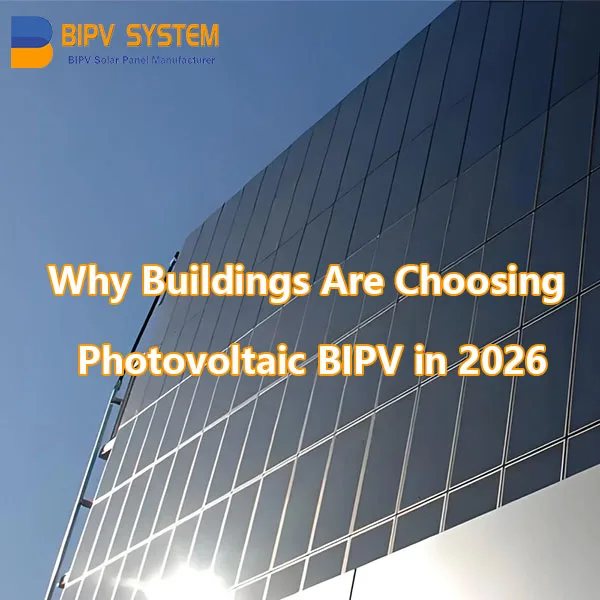
Building-integrated photovoltaics (BIPV) embeds solar cells directly into the building envelope — replacing conventional materials like roof tiles, facade cladding, and curtain wall glazing — so the same surface simultaneously generates clean electricity and fulfills its structural or weather-sealing function. That’s the definition. But the reason architects, developers, and EPC contractors are moving toward it right now isn’t about the definition. It’s about regulation pressure, the real cost equation, and the hard reality that buildings consuming 40% of global energy can no longer be designed as passive consumers.
If you’ve been watching this space, you already know the shift is happening. This article is about understanding why — precisely enough to make a confident decision for your next project.
Table of Contents
The Shift Nobody Predicted Five Years Ago
I’ll be honest with you. Five years ago, when a client asked about BIPV, my first internal reaction was: interesting idea, but we need to talk about cost. The premium over conventional building materials was real, the efficiency trade-offs on vertical facades were real, and the supply chain for quality BIPV systems was still immature.
That conversation has fundamentally changed.
The global BIPV market was valued at $29 billion in 2024 and is expected to reach around $138 billion by 2034 — a CAGR of 16%, driven by tightening building energy codes, accelerating urbanization, and declining solar technology costs. More telling than the market number: countries across the world are now integrating BIPV into public infrastructure, smart city initiatives, and commercial projects specifically to meet carbon reduction targets.
This is no longer a niche. It’s becoming a baseline expectation in high-performance building design.
What Photovoltaic BIPV Actually Means (And What It Doesn't)
Before we go any further, one line needs to be drawn clearly. I see it confused in project briefs constantly.
BIPV ≠ BAPV.
BIPV (Building-Integrated Photovoltaics): The solar element replaces a conventional building material. A PV glass curtain wall that takes the place of standard glazing units. A solar roof tile that replaces conventional roofing. One component, two functions.
BAPV (Building-Applied Photovoltaics): Solar panels added onto an existing, completed building envelope. The standard rack-mounted rooftop installation you’ve seen everywhere — that’s BAPV. Functional, but additive. It doesn’t replace anything.
Why does this distinction matter commercially? Because in a true BIPV system, the solar collectors serve a dual function: protecting the structure from external environmental conditions while simultaneously generating electrical power. Since BIPV replaces other building materials, the actual cost premium over doing nothing is smaller than it first appears — you are offsetting the cost of the conventional material you’re no longer buying.
That single reframe changes most of the financial conversations I have with clients.
Why “It’s Just Solar on a Building” Is the Wrong Mental Model
Here’s the mental model I see cause the most damage in early design decisions: treating BIPV as “solar panels that happen to be on a wall” instead of “a building skin that also generates revenue.”
When you think of it as solar panels on a wall, your comparison benchmark is a rooftop solar installation — and BIPV looks expensive. When you think of it as a building skin, your comparison benchmark is conventional cladding plus a separate solar system — and the math looks very different.
The right question is never “is BIPV cheaper than standard solar?” The right question is “what is the total cost of a building envelope that also generates electricity, compared to a building envelope that doesn’t?”
The Six Reasons Buildings Are Choosing Photovoltaic BIPV Right Now
1. Buildings Consume 40% of Global Energy — And That's No Longer Acceptable
Buildings absorb about 40% of energy globally, with commercial and residential buildings alone utilizing nearly 70% of a country’s total electricity. Around 60% of energy consumption in buildings is allocated to cooling, ventilating, or heating.
Every major market — the EU, the US, China, the Middle East — is tightening building energy codes because of this. In Europe, the Energy Performance of Buildings Directive (EPBD) now mandates nearly zero-energy building (nZEB) standards for new construction. In California, Title 24 requires solar on most new residential buildings. In the UAE, Estidama Pearl ratings are increasingly factoring in on-site generation.
BIPV turns a building’s largest surfaces — the roof and facade — into the solution. By utilizing building surfaces for on-site electricity generation, BIPV is fundamental to supporting the energy transition necessary to lower dependence on fossil fuels, transforming energy consumption in buildings to be less polluting and more resilient.
This isn’t optional for long. The regulatory direction is clear.
2. Facades Are the Last Untapped Energy Surface
Here’s something I explain to architects regularly: in a mid-rise or high-rise building, the roof area is tiny relative to the facade. A 20-story office tower might have 500 m² of roof and 8,000 m² of exterior wall. Multi-story and high-rise buildings have much more exterior wall surface area than rooftop area — making solar facades, parking structures, or awnings a compelling alternative to rooftop panels.
Research in Dubai showed that adding BIPV on windows and exterior walls reduces high-rise building energy consumption by up to 32%. That’s not a marginal gain. That’s a figure that changes the financial model of a building.
The design implication is real though. Vertically placing PV panels on a facade reduces power output by approximately 50% compared to the optimal tilt angle — so the engineering case requires understanding that the area advantage of a large facade can compensate for the orientation inefficiency. Our team at BIPVSystem uses detailed simulation tools to validate the energy yield case for specific facade orientations before any procurement decision is made.
3. The Net Cost Is Better Than It Looks
This is the conversation I have most often — and the one where I see the most confusion.
A Photovoltaic BIPV facade costs more per square meter than standard cladding. That’s true. But the comparison clients should be running is:
Cost of BIPV facade vs. Cost of conventional cladding + cost of rooftop solar + cost of additional land/infrastructure
A 6,000 m² BIPV facade at a Canadian university produced approximately 420,000 kWh annually — saving around $100,000 per year — with a comparable 100,000 sq ft Texas project projected to generate over $5.5 million in energy savings over 30 years.
A peer-reviewed 2025 case study published in Energies (MDPI) examined a full-size BIPV facade in Berlin — a ventilated curtain wall building retrofitted with colored CIGS modules at 12.3% efficiency. The study confirmed that standard substructure constructions are suitable for PV facades, and that the amortization period depends on two key questions: how much higher is the initial investment, and how long until the additional costs are paid off through solar generation savings. In the German case, with electricity at €0.26/kWh for non-households, the payback period was commercially viable within the building’s lifecycle.
The financial case is project-specific. But dismissing BIPV as “too expensive” without running the dual-function cost comparison is a mistake I’ve seen project teams regret.
4. Green Certification Is Now a Commercial Requirement
BIPV contributes significantly to sustainable building goals — supporting green building certifications like LEED and BREEAM — and reduces carbon footprint while supporting compliance requirements.
This isn’t just about environmental virtue. It’s about commercial reality. In the EU, ESG reporting requirements now affect how institutional investors and banks assess building assets. A BREEAM Outstanding or LEED Platinum certification affects refinancing terms, tenant attraction, and asset valuation.
Photovoltaic BIPV can contribute points across multiple LEED v4 credit categories: Energy & Atmosphere (on-site renewable), Materials & Resources (replacing conventional cladding with multi-function material), and Innovation. Your sustainability consultant needs to know the system details early — which is another reason we recommend bringing BIPV specification into the design brief at schematic phase, not after the facade is already engineered.
5. Aesthetic Integration Is No Longer a Compromise
I remember the first time a client saw our colored PV glass samples. The reaction was: “This doesn’t look like solar.” That’s exactly the point.
The design of BIPV systems influences the energy performance, environmental comfort, and aesthetics of buildings. The variety of colors and textures beyond traditional dark blue panels enhances visual appeal and contributes to public acceptance.
Modern Photovoltaic BIPV products — from custom-colored glass-glass laminates to textured silicon modules — can match an architect’s facade specification without the visual compromise that traditional PV arrays impose. The Avancis Skala colored modules used in the Berlin living laboratory appear like conventional, non-solar-active components — with busbars only visible from less than 2 meters away.
For historic buildings, landmark facades, or any project where architectural expression matters, this evolution in product aesthetics changes what’s possible. Integrating solar PV into historic buildings has become increasingly important — using solar power systems that are visually unobtrusive could be the most acceptable approach for preservationists.
6. Photovoltaic BIPV Delivers Dual-Function Value That Standalone Solar Cannot
This is the engineering argument I find most compelling.
A standard rooftop solar installation generates electricity. Full stop.
A BIPV curtain wall system generates electricity and provides weatherproofing, structural wind load resistance, thermal insulation, acoustic dampening, solar shading, and fire classification. Photovoltaic BIPV integrates photovoltaic cells into the building envelope, turning components like tiles, cladding, and windows into electricity-generating surfaces while also providing insulation, weather protection, noise reduction, and other functions.
Incorporating photovoltaics into the building envelope reduces the extra cost of PV installation and lowers the structure’s life-cycle cost by eliminating the need for conventional materials at the construction site.
When you’re paying for building envelope materials anyway — glass, cladding panels, roofing — the question becomes: why not pay for materials that also generate revenue?
The Real Pain Points — And How to Navigate Them
I’m not going to pretend BIPV is without challenges. The projects I’ve seen go wrong almost always trace back to three root causes. Understanding them is how you avoid the same mistakes.
Pain Point 1: Entering the Design Process Too Late
BIPV cannot be bolted onto a finished building design. The orientation, shading analysis, structural loading, electrical routing, and waterproofing integration all need to be resolved during the design development phase — not during construction documentation.
The successful implementation of BIPV hinges on careful assessment of building orientation and facade configuration to maximize solar exposure — optimizing window placements, tilt angles, and shading devices. Collaboration between architects, engineers, and manufacturers is essential to ensure the system harmonizes with the overall design vision while delivering optimal energy output.
My recommendation: bring your BIPV supplier into a technical pre-design consultation before schematic design is frozen. At Industrial BIPV Solution, we offer early-stage feasibility assessments that include preliminary energy yield modeling, system typology selection, and envelope integration strategy — all before any cost commitment.
Pain Point 2: Confusing Module Efficiency with System Value
A client once told me: “We chose a different supplier because their panel efficiency is 22% versus your 18%.” I understood the logic. I also knew it was the wrong question.
On a vertical facade, the solar angle means you’re never operating at STC conditions. Vertically placed PV panels on a facade produce approximately 50% less power than at the optimal angle — so an efficiency gain of 4 percentage points on the module spec translates to roughly 2 percentage points of real-world gain on a south-facing vertical surface, and near zero on a north facade.
What matters is annual energy yield per project, not module datasheet efficiency. These are calculated from simulation tools like PVsol or EnergyPlus with actual building geometry, local irradiance data, and realistic shading loss models.
Pain Point 3: Overlooking Weatherproofing at the Panel Interface
This is the technical failure mode I see most often in post-construction claims. The PV module itself is a weatherproof unit. But the interface between the module frame, the substructure, and the building’s waterproofing membrane is where water ingress happens.
A true BIPV system specification must address: drainage channel design, ventilation gap behind the modules (for both thermal performance and condensation management), sealant compatibility with both the module material and the underlying structure, and fire classification at the assembly level — not just the module level.
Our BIPV modules and facade systems include complete installation documentation, including drainage calculations and structural fixing data, precisely because we’ve seen what happens when these details are left to the site team to figure out.
Where BIPV Works Best: Application Typology Guide
Not every building surface is equally suited for BIPV. Here’s how I think about typology selection:
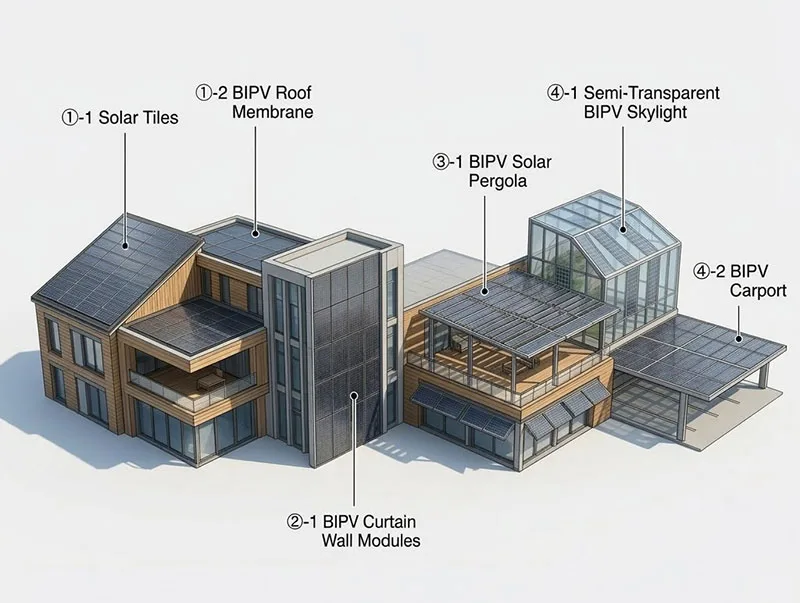
Roof Systems (pitched and flat) The highest energy yield per m², easiest to integrate, most common entry point. Suitable for industrial, commercial, and residential buildings. Products range from in-roof BIPV systems that replace the waterproofing membrane, to solar tile systems that replace conventional roof tiles. Flat and pitched roofs currently hold the highest BIPV market share and are generally more efficient than facade and cladding systems due to their orientation to the sun.
Ventilated Facade Systems The second-largest and fastest-growing BIPV typology. The “living laboratory” BIPV project in Berlin demonstrated both the technical viability and architectural potential of PV integration on a ventilated curtain wall — a system type that is both a typical commercial building construction and a unique showcase for BIPV technology. Best suited for commercial offices, institutional buildings, and high-rise residential.
Semi-Transparent Glazing and Skylights Semi-transparent BIPV systems are typically used in greenhouse, atrium, or daylighting applications where solar energy must be captured while still allowing light into the building. The trade-off is lower efficiency versus the dual benefit of energy generation plus controlled natural daylighting. Apple Park in Cupertino is the most widely cited commercial example — the roof incorporates BIPV modules for renewable energy generation while the building’s glass facade also integrates photovoltaic technology.
Solar Shading / Awnings / Brise Soleil Often the easiest BIPV application to justify financially, because the shading device is needed anyway, and the PV function is additive at low marginal cost. PV may be incorporated into awnings and saw-tooth designs on a building facade, with the module tilt improving solar access relative to a vertical surface while the shading function reduces the building’s cooling load.
Carports and Infrastructure Perhaps the most common forms of BIPV are carports or parking shade structures with PV panels built directly into them — one of the clearest examples where the dual-function value case is immediately legible to a building owner.
BIPV vs. Conventional Rooftop Solar: The Honest Comparison
| Dimension | Conventional Rooftop Solar (BAPV) | BIPV |
|---|---|---|
| Installation timing | After building is complete | Integrated during design/construction |
| Cost comparison | Lower module cost | Higher module cost, offsets cladding material cost |
| Roof space use | Occupies roof area | Replaces building material; no extra space consumed |
| Facade application | Not applicable | Core application typology |
| Aesthetic impact | Visible add-on | Architecturally integrated |
| Building envelope function | None | Weatherproofing, thermal, structural |
| Green cert contribution | Energy credits only | Energy + materials + innovation credits |
| High-rise suitability | Limited by roof area | Scales with facade area |
| Payback period | Typically 5–10 years | Typically 8–20 years (narrowing as costs fall) |
The right answer depends on your project. For a low-rise warehouse where roof space is ample and aesthetics are irrelevant, conventional rooftop solar wins on simplicity. For a commercial office tower in a dense urban context targeting LEED Gold and needing a distinctive facade, BIPV is the correct solution.
Real Projects That Changed How I Think About BIPV
Berlin BIPV Curtain Wall Living Lab — A research building in Berlin with 48.72 kWp of frameless, blue-colored CIGS modules on its ventilated curtain wall facade. The modules appear identical to conventional non-solar components — with busbars only visible at less than 2 meters. The project demonstrated, under real monitored conditions, that standard curtain wall substructures can host BIPV without specialized modifications.
St. Mary’s University, Canada — A 6,000 m² Mitrex solar facade that produces approximately 420,000 kWh annually, saving $100,000 per year and achieving ROI in under one year, while avoiding approximately 282 tonnes of CO₂ emissions annually — helping the university meet its 20% renewable energy target.
Apple Park, Cupertino — The roof of Apple Park uses BIPV modules to generate renewable energy, while the building’s glass facade also incorporates photovoltaic technology. At 175 acres, it remains one of the most visible BIPV installations globally — demonstrating that scale and architectural ambition are compatible with integrated PV.
Bahrain World Trade Center — The BWTC incorporates three massive wind turbines within the structure alongside BIPV panels, generating a substantial portion of the building’s electricity needs — one of the earliest and most dramatic examples of energy generation as a core architectural expression.
What the Research Actually Says
I want to cite the peer-reviewed literature directly here, because this is the basis on which serious engineers should evaluate BIPV — not marketing brochures.
A comprehensive 2025 multi-level design review published in Renewable and Sustainable Energy Reviews (ScienceDirect) found that the aesthetics of BIPV has a value strongly connected to its public acceptance, and that new technologies are key to creating innovative solutions for efficiency and cost issues — with design being a determinant feature that dictates system performance.
A 2024 paper in Energy Science & Engineering (Wiley) confirmed that semitransparent PV systems represent a revolutionary juncture — facilitating natural daylight within buildings while simultaneously generating clean energy, with their ability to modulate light and heat ingress enhancing indoor environmental quality and potentially reducing reliance on artificial climate control systems.
The IEA published a 179-page technical guidebook for BIPV in 2025 — the most authoritative design reference currently available, and a signal of how seriously the international energy community is taking this technology’s scaling potential.
How BIPVSystem Approaches This Differently
I’ve spent the better part of this article explaining why BIPV makes technical and commercial sense. Let me be specific about where the design challenge actually sits — and how we approach it.
Most BIPV projects fail not because of the panel technology, but because the system interface isn’t properly engineered. The panel is a photovoltaic product. The building is a structural, thermal, and waterproofing system. The gap between those two domains is where problems are born.
At BIPVSystem, we design from the building brief inward. We start with your architectural intent, your structural system, your local building code requirements, and your energy performance target — then work backwards to the panel specification. That means our BIPV modules and facade systems are never just panels. They come with drainage calculations, structural fixing documentation, fire classification data, and BIM-compatible models.
We work across the full application spectrum: ventilated facade BIPV, semi-transparent glazing systems, in-roof BIPV, and custom curtain wall integration. And because we work directly with the manufacturing process, we can produce custom dimensions, custom transparency levels (from opaque to approximately 40% visible light transmission), and custom color treatments within a lead time that suits your construction program.
If you’re at an early design stage and want to understand what’s technically feasible for your project, talk to our BIPV engineers before you finalize the facade specification.