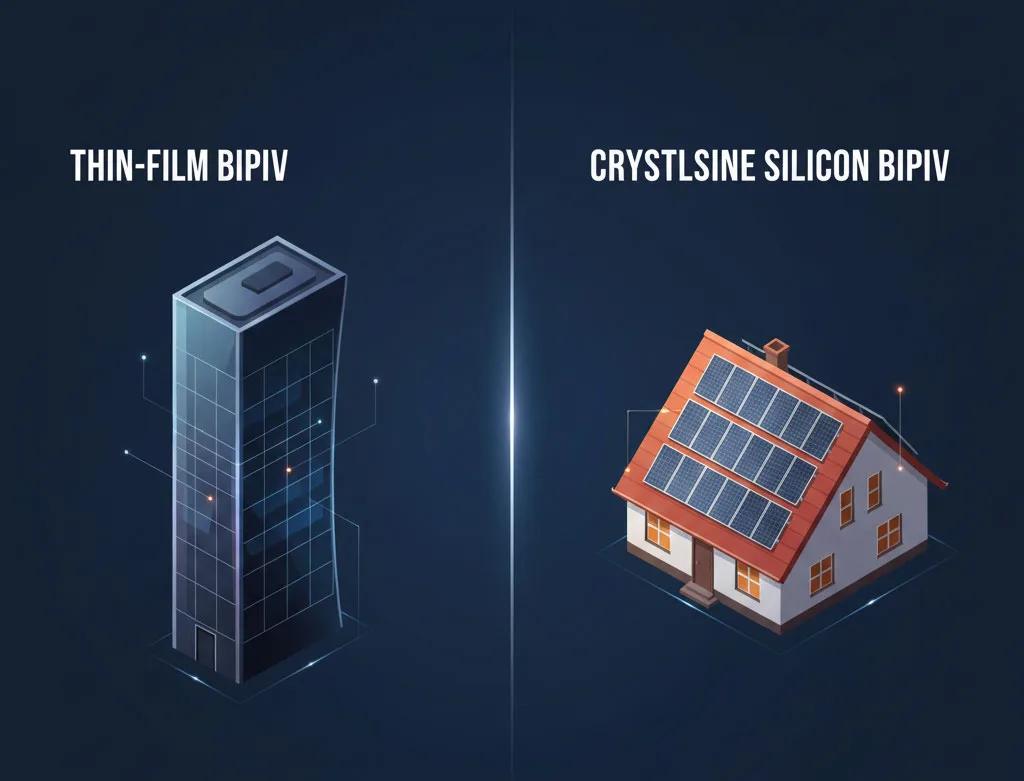
Thin film BIPV and crystalline silicon BIPV are the two primary building-integrated photovoltaic technologies used in modern architecture, differing fundamentally in material structure, electrical performance, and architectural integration.
Choosing between crystalline silicon BIPV and thin-film BIPV is the most critical technical decision in solar architecture. Crystalline silicon BIPV utilizes solid silicon wafers to offer high energy conversion efficiency and durability, making it ideal for high-yield roofs. In contrast, thin film BIPV involves depositing light-absorbing layers onto substrates like glass or stainless steel, resulting in a lightweight, flexible, and aesthetically versatile material that excels in low-light conditions and seamless facade integration.
Understanding the difference between thin film BIPV and crystalline silicon BIPV is essential for architects and developers, because the right choice affects not only energy generation, but also facade design, daylight control, system lifespan, and long-term building performance.
Table of Contents
What Is Thin Film BIPV?
If your building has a massive flat roof or south-facing facade with zero shade, crystalline silicon BIPV is usually your best friend. These are the “traditional” looking solar cells—the distinct squares you see behind glass.
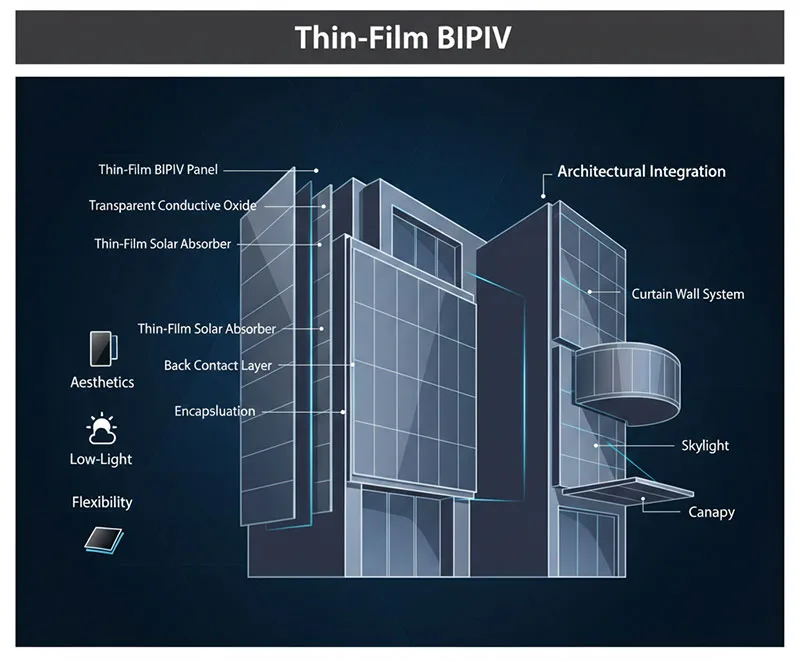
Thin film BIPV (often using materials like CIGS or Cadmium Telluride) is the technology that made architects fall in love with solar again. Instead of rigid wafers, it’s a uniform layer of “energy-catching” material.
From an architectural perspective, thin film BIPV behaves more like a functional building skin than a conventional solar module.
Key characteristics of thin-film BIPV include:
Uniform appearance without visible cell patterns
Better performance under diffuse and low-light conditions
Higher design flexibility in size, shape, and transparency
Easier integration into architectural glass systems
Thin-film BIPV is widely applied in:
Skylights and atriums
Canopies and shading structures
Aesthetics: It’s almost perfectly uniform. If you want a building that looks like a seamless obsidian mirror, thin film is the way to go.
Low-Light Performance: Here’s a secret: thin film is better at “waking up” early. It starts generating power in dawn, dusk, and even on cloudy days better than crystalline silicon.
Think of thin film like a high-end camera lens that can still take a great photo in a dark room. Crystalline silicon needs that bright, direct “studio lighting” to really shine.
What Is Crystalline Silicon BIPV?
If your building has a massive flat roof or south-facing facade with zero shade, crystalline silicon BIPV is usually your best friend. These are the “traditional” looking solar cells—the distinct squares you see behind glass.
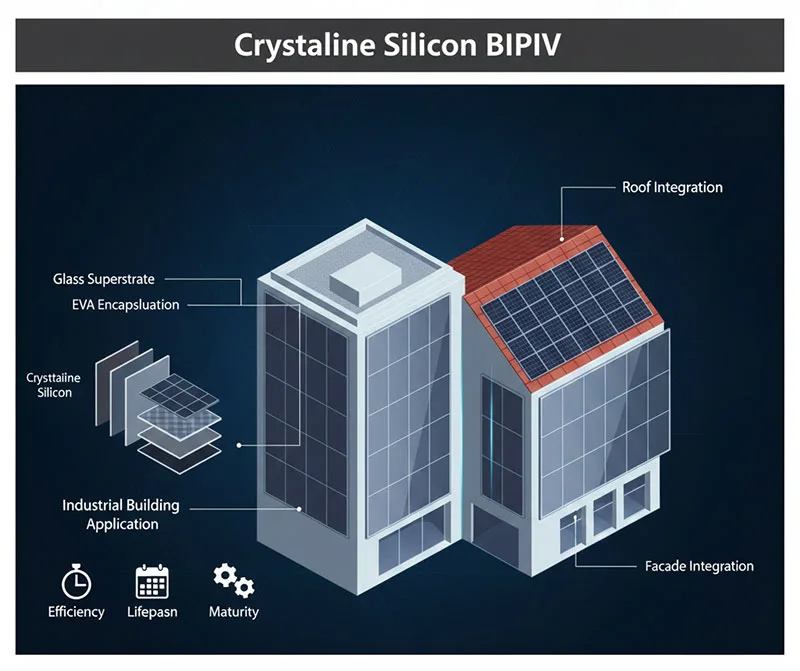
Crystalline silicon BIPV is based on mono-crystalline or poly-crystalline silicon solar cells, the most mature photovoltaic technology on the market.
In BIPV applications, crystalline silicon modules are engineered to function as building materials, such as roof coverings or opaque facade panels, while simultaneously generating electricity.
Crystalline silicon BIPV is commonly used in:
Opaque facade zones
Industrial and commercial buildings
Efficiency: They are the Olympic athletes of solar. They typically offer 18% to 22% efficiency.
Lifespan: These things are tanks. We’ve seen c-Si systems running strong after 25 years with very little degradation.
To be honest, they can look a bit “busy” because of the visible cell patterns and busbars (the tiny silver wires). If you’re going for a high-tech, industrial look, they are perfect. But if you want a “hidden” solar wall, they might be too loud.
Thin Film BIPV vs Crystalline Silicon BIPV: Key Technical Differences
1. Material and Structure
Crystalline silicon BIPV: Thicker cell structure, visible cell layout
Thin-film BIPV: Ultra-thin layers, homogeneous surface appearance
2. Energy Performance Logic
Crystalline silicon: Higher peak efficiency, orientation-sensitive
Thin film: Lower peak efficiency, but more stable under non-ideal angles
3. Architectural Integration
Crystalline silicon: Engineering-driven integration
Thin film: Architecture-driven integration
There is no universally “better” option—only a more appropriate BIPV technology for a specific project context.
The Direct Comparison: Which is for you?
| Feature | Crystalline Silicon (c-Si) | Thin Film BIPV |
|---|---|---|
| Efficiency | High (18-22%) | Moderate (10-15%) |
| Appearance | Visible cells/patterns | Uniform, sleek, "all-black" |
| Temperature | Sensitive (Performance drops when hot) | Stable (Better heat tolerance) |
| Weight | Heavier | Lightweight |
| Best Use | High-yield roofs, large facades | Curved surfaces, glass curtain walls |
A Story from the Field: The Shadow Trap
I once worked on a project where the client insisted on crystalline silicon for a facade that was partially shaded by a neighboring tree for three hours a day. Because of how c-Si cells are wired in “strings,” if one cell is shaded, the whole panel’s performance can tank—like a kink in a garden hose.
We eventually convinced them to switch to thin film. Why? Because thin film is much more “shade-tolerant.” Even with the tree shadow, the thin film system ended up producing more total energy over the year than the “more efficient” crystalline option would have. That’s why I always say: Context is king.
Which BIPV Technology Is Right for Your Project?
In real BIPV projects, the decision is rarely based on efficiency alone. Instead, it depends on project priorities:
Choose crystalline silicon BIPV when:
- Maximizing energy output is critical
- Roof or opaque facade areas dominate
- Standardized construction is preferred
Choose thin-film BIPV when:
- Visual uniformity matters
- Daylighting and transparency are required
- The facade is a core architectural feature
Advanced BIPV projects often combine both technologies in different building zones to balance performance and design.
Frequently Asked Questions (People Also Ask)
What is the main difference between thin-film BIPV and crystalline silicon BIPV?
The main difference lies in material structure and architectural suitability. Thin-film BIPV offers better visual uniformity and design flexibility, while crystalline silicon BIPV provides higher power output per square meter.
Is thin film BIPV cheaper than crystalline silicon?
Initially, thin film modules can be cheaper per square meter, but because they have lower efficiency, you might need more surface area (and more mounting hardware) to reach the same power output. In high-end BIPV applications, the costs are often comparable once integration is factored in.
Is thin-film BIPV less efficient than crystalline silicon BIPV?
Yes, thin-film BIPV typically has lower peak efficiency, but it performs more consistently under diffuse light and non-ideal orientations.
Can thin film and crystalline silicon BIPV be used together?
Yes. Many projects combine both technologies in different areas of the same building to optimize energy generation and architectural performance.
Summarize
At BIPVSystem, we don’t believe in “one size fits all.” Whether you need the raw power of crystalline silicon for an industrial roof or the architectural elegance of thin film for a landmark facade, we’ve spent years refining the engineering to make it work.
Would you like me to run a simulated yield comparison for your specific building location to see which technology generates more ROI for you?Please contact us to get a free solution.