As the green building movement accelerates, homeowners are no longer satisfied with bolting bulky solar panels onto existing roofs. The market is shifting rapidly toward BIPV (Building-Integrated Photovoltaics)—a solution where your roof is the power source.
However, the most common question we receive at BIPVSYSTEM is straightforward: “What is the real BIPV system cost, and is it worth the investment?”
In this comprehensive 2025 guide, we will dismantle the factors influencing the total residential BIPV system cost, helping you move from “curious” to “informed investor.”
Table of Contents
The Cost Anatomy of a BIPV System: Where Does the Money Go?
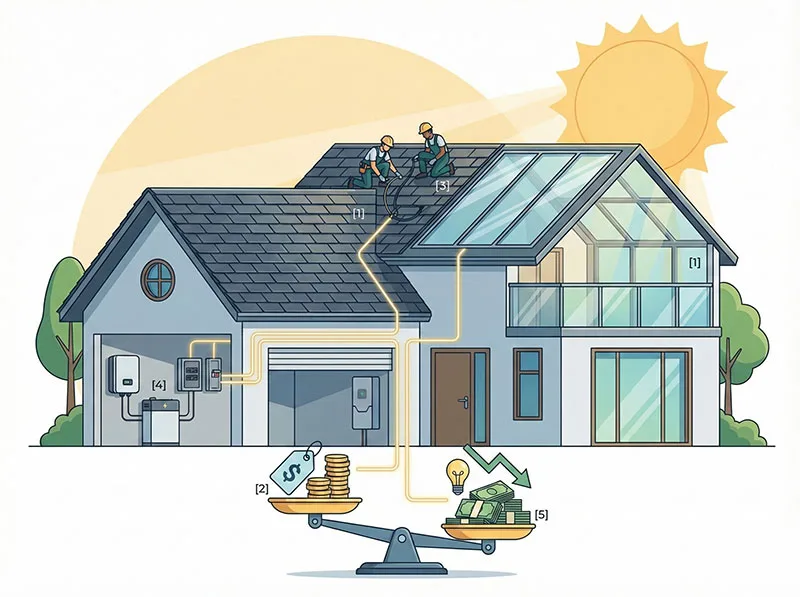
Unlike traditional “bolt-on” solar (BAPV), BIPV serves a dual purpose: it is both an energy generator and a fundamental building material. Consequently, the BIPV system cost structure is unique. Here are the four main pillars that determine your final price tag:
A. Hardware Costs (Approx. 40-50%)
This is the core material cost.
BIPV Modules: The BIPV solar tile, glass, or facade materials that generate power. Your BIPV system cost will vary based on efficiency and aesthetics (e.g., all-black, textured, or colored options).
Dummy Modules: To ensure your roof looks seamless, non-generating “dummy” tiles are used on edges, around chimneys, or in shaded areas. This ensures high “Curb Appeal.”(see examples in our Project Gallery)
Inverters & Optimizers: To maximize output despite complex roof angles, we recommend Micro-inverters. These are a critical component of the BIPV system cost that ensures long-term efficiency.
Battery Storage: Optional, but increasingly standard in markets with high electricity rates (like Europe and California) to store excess solar power for night use.
B. Structural & Waterproofing (The "Roof" Part)
Waterproofing System: Since BIPV modules replace roof tiles, a specialized mounting system is essential. BIPVSYSTEM uses a proprietary design to ensure watertight performance, which optimizes the long-term maintenance aspect of your BIPV system cost.
Flashings & Trim: Custom metalwork for ridges, eaves, and valleys to ensure a clean finish.
C. Labor & Installation
When calculating the BIPV system cost, labor is a significant factor involving cross-disciplinary work:
Roofing Crew: Handles the physical layout, waterproofing, and structural integrity.
Electricians: Handles the wiring, inverter setup, and grid connection.
Note: While BIPV installation is more intricate than standard solar, it is often faster than installing a roof AND solar panels separately.
D. Soft Cost
System Design & Permitting: Custom engineering and local government fees are unavoidable parts of the residential BIPV system cost.
Permitting: Local government building permits and utility interconnection fees.
2025 Estimated Cost Table
To give you a realistic idea, we have compiled estimates based on typical market rates for developed countries (USA, Europe, Australia).
Note: The BIPV system cost below includes hardware, installation, and basic components.
| Large Villa | 10 - 15 kW | 90 - 130 ㎡ | $18,000 - $28,000 | $8,000 - $12,000 | $26,000 - $40,000 | -$10,000 |
|---|---|---|---|---|---|---|
| Small Home | 3 - 5 kW | 25 - 40 ㎡ | $5,000 - $9,000 | $3,000 - $5,000 | $8,000 - $14,000 | -$3,000 |
| Medium Home | 6 - 9 kW | 50 - 80 ㎡ | $10,000 - $16,000 | $5,000 - $8,000 | $15,000 - $24,000 | -$6,000 |
| Waterproofing | Good (Depends on site labor) | Excellent (Factory sealed) | Fair (Depends on sealant) | Open joint (Rainscreen) | Open joint (Rainscreen) | Open joint (Rainscreen) |
Key Insight (The “Offset Cost”): When evaluating the BIPV system cost, you must subtract the cost of the traditional roof you didn’t have to buy. If you are building new, the marginal BIPV system cost is often 30-40% lower than the table figures.
Government Incentives & Subsidies (2025 Update)
Government policies can significantly lower the effective BIPV system cost and improve your ROI. Here is a snapshot of major markets in 2025:
United States (Federal)
Investment Tax Credit (ITC): Currently at 30%. If your system costs $20,000, you receive a $6,000 federal tax credit.
Europe
Germany: 0% VAT on residential PV systems and feed-in tariffs for excess power.
United Kingdom: 0% VAT on energy-saving materials (including solar roofs).
France/Italy: “Eco-bonus” schemes for deep energy retrofits on existing buildings.
Australia
STCs (Small-scale Technology Certificates): This acts as an upfront discount, typically covering roughly 30% of the system cost depending on your zone.
Government Incentives & Subsidies (2025 Update)
Not all integrated roofs are created equal. When analyzing the BIPV system cost against long-term value, BIPVSYSTEM stands out by solving legacy problems.
The BIPVSYSTEM Advantage vs. Traditional Solar/Old BIPV:
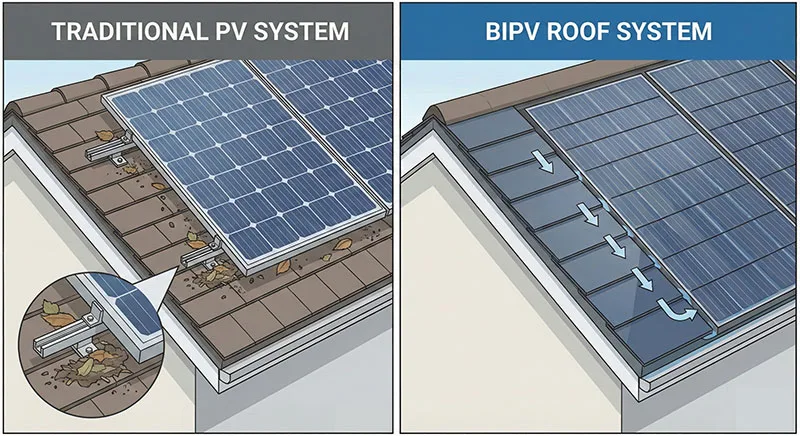
Superior Waterproofing: Unlike systems that rely on sealants (which degrade over time), our system uses a mechanical interlocking design that physically channels water away.
Rapid Installation: Our modular design snaps together, reducing labor hours by up to 30% compared to custom BIPV solutions.
Ventilation & Efficiency: We incorporate an air-gap structure beneath the modules, allowing heat to escape and keeping the solar cells operating at peak efficiency.
FAQ: Top 3 Questions About BIPV System Cost
If one BIPV tile breaks, is it expensive to repair? Do I have to replace the whole roof?
This is a common misconception that scares many homeowners. Unlike old integrated systems, modern BIPVSYSTEM solutions use a modular design.
The Cost Reality: You generally do not need to replace the entire roof. If a single tile is damaged (e.g., by a fallen tree branch), a technician can typically unlock and replace just that specific unit.
Maintenance Budget: While the labor cost for a specialized technician is slightly higher than a standard roofer (expect roughly $150-$300 for a service call plus the tile cost), it is significantly cheaper than repairing a structural leak in a traditional roof caused by old solar mounting holes.
Can a BIPV roof withstand hail and fire? Will it lower my insurance costs?
Durability is a huge part of the “long-term cost” equation.
Impact Resistance: High-quality BIPV modules are tempered glass, often rated to withstand hailstones up to 25mm traveling at 50mph (Class 4 Impact Rating). They are often more durable than standard asphalt shingles or clay tiles, which crack easily.
Insurance Savings: Because BIPV acts as a fire-resistant and impact-resistant upgrade, many insurance companies view it favorably. While you should confirm with your provider, upgrading to a durable BIPV roof can sometimes stabilize or even reduce your home insurance premiums compared to maintaining an older, vulnerable roof.
Is BIPV really cheaper than installing a new roof plus traditional solar panels?
This is a common misconception that scares many homeowners. Unlike old integrated systems, modern BIPVSYSTEM solutions use a modular design.
The Cost Reality: You generally do not need to replace the entire roof. If a single tile is damaged (e.g., by a fallen tree branch), a technician can typically unlock and replace just that specific unit.
Maintenance Budget: While the labor cost for a specialized technician is slightly higher than a standard roofer (expect roughly $150-$300 for a service call plus the tile cost), it is significantly cheaper than repairing a structural leak in a traditional roof caused by old solar mounting holes.
Conclusion: Expense vs. Investment
The sticker price of a residential BIPV system is higher than a standard asphalt roof. However, when you view it over a 25-year timeline, the math changes:
Avoided Roofing Costs: You don’t need to buy roof tiles.
Energy Savings: You eliminate electricity bills, recouping the BIPV system cost usually within 5-7 years.
Property Value: Homes with solar—especially aesthetic BIPV—sell faster and for a premium.
Are you ready to transform your roof? Don’t let complex calculations stall your project.
👉 Contact a BIPVSYSTEM Expert Here Send us your roof dimensions today for a free, personalized cost-benefit analysis.