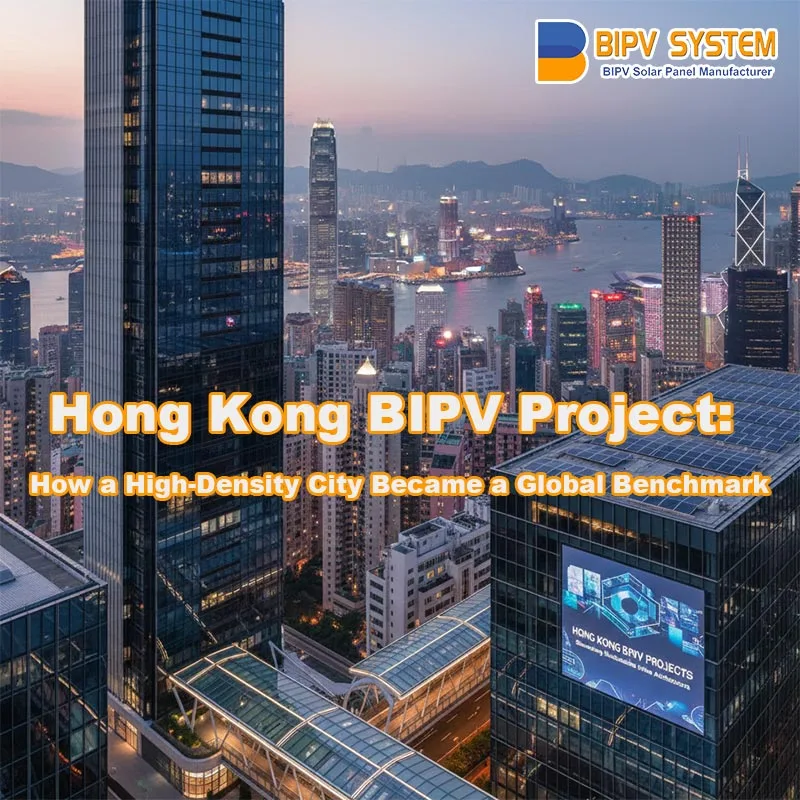
Hong Kong BIPV Project refers to the strategic integration of solar photovoltaic technology into the structural envelope of skyscrapers—such as facades, skylights, and sunshades—specifically engineered to overcome the challenges of extreme urban density and typhoon-force wind loads. By treating the building’s ‘skin’ as an energy asset rather than just a shell—a core part of the BIPV meaning that defines modern sustainable construction—these projects serve as a benchmark, these projects serve as a global benchmark for cities where land is scarce and verticality is the only option for renewable expansion. Supported by the Hong Kong Climate Action Plan 2050 and the Feed-in Tariff (FiT) scheme, this model demonstrates how architectural aesthetics and high-performance energy production can coexist in a sub-tropical high-rise environment.
As someone who has spent years analyzing BIPV performance data across Asia, I’ve always found Hong Kong to be the ultimate “proving ground.” If a BIPV system can survive a Hong Kong summer—with its intense humidity, complex shadowing from neighboring skyscrapers, and the occasional T10 typhoon—it can survive anywhere. In 2026, as we look at the results of the latest Feed-in Tariff (FiT) reviews, it’s clear that the “Hong Kong Model” is the blueprint for future mega-cities.
Hong Kong became a BIPV benchmark because it proved BIPV can work in dense urban conditions: limited roof area pushed PV onto façades and sunshades; government and industry ran monitored pilot projects; and later policy tools (like the Feed-in Tariff) improved project economics—creating a repeatable pathway from demonstration to wider adoption.(From Hong Kong Government News Network)
Table of Contents
Why Hong Kong is the “stress test” city for BIPV
In most cities, solar is a rooftop game. But in Hong Kong, where buildings often have more facade area than rooftop space, the “vertical real estate” is the true goldmine.
The technical complexity here is staggering. When we design a Hong Kong BIPV Project, we aren’t just calculating sunlight; we are calculating “diffuse light” and “reflected radiation” from surrounding glass towers. I remember reviewing a project in Kowloon where the reflected light from a neighboring building actually increased the BIPV output by 12% during certain hours—a phenomenon we call “albedo gain.”
Hong Kong’s own public materials repeatedly frame this reality: distributed renewable energy matters because the city has natural and geographical constraints, so the community has to develop on-site/distributed RE to tap what’s feasible.
That constraint is exactly what forces better engineering decisions:
Façade and shading PV becomes meaningful, not optional.
Glazing + PV must still pass real building performance requirements.
Maintenance and monitoring can’t be an afterthought (dense cities punish “hard-to-access” designs).
Case Study 1: Wan Chai Tower (Government pilot that made BIPV “real”)
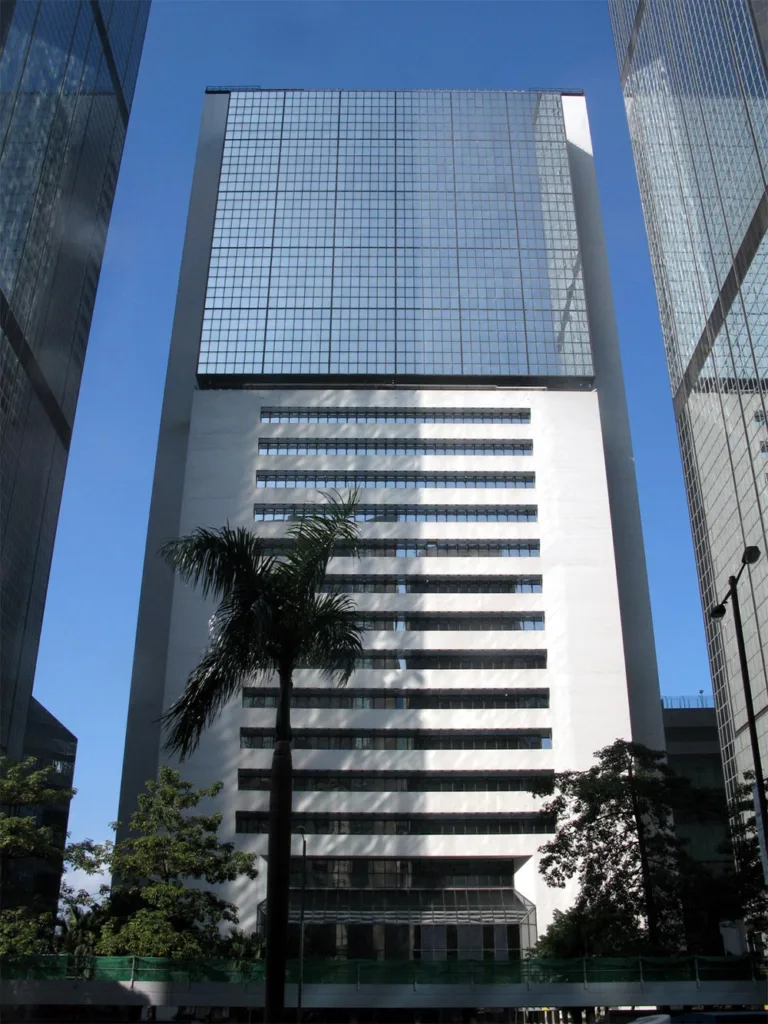
If you want one project that screams “high-density BIPV proof,” it’s Wan Chai Tower—a high-rise government office building in a congested urban area used as a formal pilot to assess BIPV performance under Hong Kong conditions.
What was installed (and why it matters)
The pilot used about 500 m² of PV with 55 kW installed capacity.
It’s not just the size—it’s the integration strategy:
Roof rack PV (standard approach, easy baseline)
Sunshade-screen BIPV (PV as façade shading device)
Skylight BIPV (PV as glazing infill / atrium element)
Government publications estimated ~30,000 kWh annual yield and CO₂ reduction on the order of ~18–23 tonnes/year (depending on the referenced communication).(Data source: Hong Kong Development Bureau / Hong Kong Government News Network)
And here’s the part that I personally think is underrated: the project wasn’t just installed; it was monitored and communicated to the public, which is a big EEAT move—transparent data builds trust.
Replicable takeaway: In dense cities, BIPV wins when it’s designed as envelope + shading + energy, not “PV stuck on later.”
Case Study 2: Hong Kong Science Park (Scaling BIPV across multiple buildings)
Wan Chai Tower proved feasibility; Hong Kong Science Park (Phase 1) showed how to scale BIPV as a campus-level design language.
EMSD’s PV project list states Science Park installed building-integrated PV on nine buildings with 198 kW total capacity.
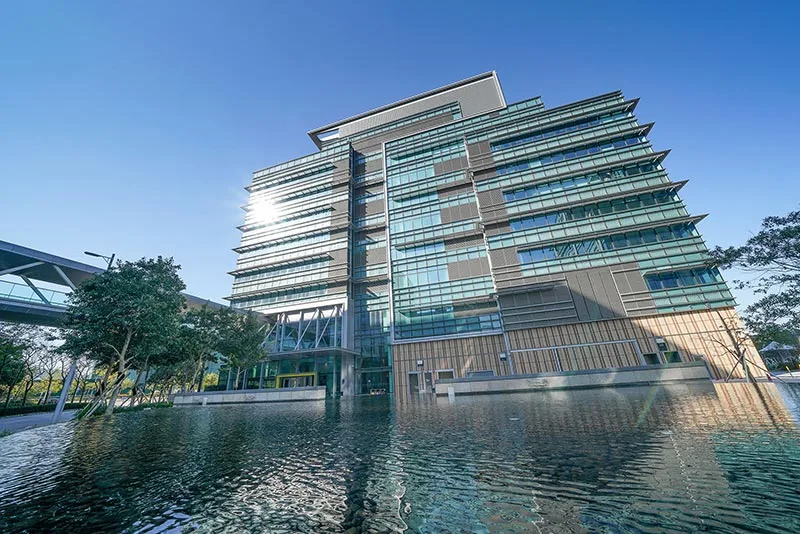
The Hong Kong Institution of Engineers (HKIE) project archive also describes the Phase 1 design including grid-connected roof-mounted and building-integrated PV panels as part of the overall building services strategy.
A BEAM Society case document adds useful “envelope-level” detail: BIPV was installed with curtain wall systems and on roofs, and the façade area used for BIPV was estimated over 1,000 m².
What makes this a high-density-city playbook (even though it’s not a skyscraper)
This is the part people miss. Even if your project is high-rise, the strategy still applies:
Treat BIPV like a repeatable façade module (curtain wall integration)
Use grid connection to avoid bulky batteries where space is premium
Standardize details across buildings to reduce engineering “reinvention” costs
Replicable takeaway: High-density cities need repeatable, curtain-wall-compatible BIPV, not one-off art pieces.
Case Study 3: CIC Zero Carbon Building / Zero Carbon Park (BIPV as performance architecture)
Hong Kong’s CIC ZCB / Zero Carbon Park is frequently cited as the city’s flagship demonstration of low/zero carbon design.
The HKGBC/BEAM Plus exhibition calls it Hong Kong’s first zero carbon building, developed with the Hong Kong SAR Government, positioned as an education and technology showcase.
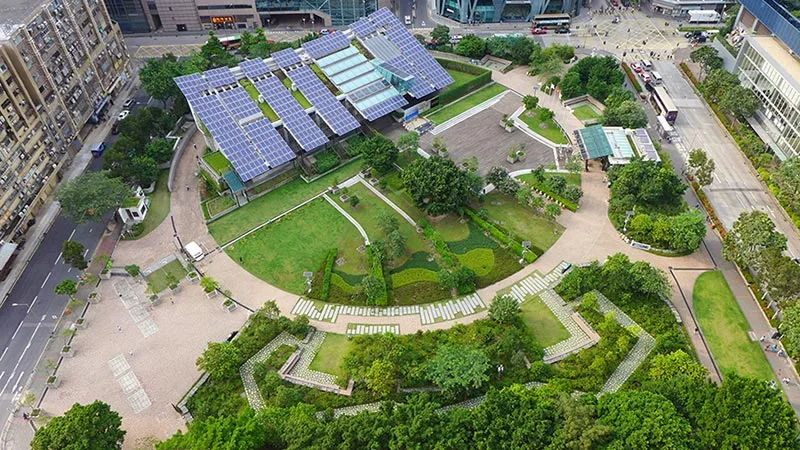
The CIC’s own “design strategy” materials explicitly mention BIPV used for the viewing deck roof, where shading and daylighting need to be optimized.
WorldGBC’s case study emphasizes a tropical/high-density context and documents the project’s certification framing and efficiency-led design approach
The Technical Pillars: Wind Load & Fire Safety
Every Hong Kong BIPV Project must adhere to the Buildings Department (BD) and Fire Services Department (FSD) codes.
Typhoon Resistance: Unlike standard panels, BIPV in HK must be rated for wind pressures that can exceed 5.0 kPa. This requires heavy-duty lamination and specialized mounting systems that are literally “built into” the building’s skeleton.
Thermal Management: I’ve seen many amateur designs fail because they forgot about the “air gap.” In HK’s heat, without a 50mm–100mm ventilation gap behind the PV facade, the cells overheat, and efficiency drops. Professional HK projects always include back-ventilation to keep the “building breath” cool.
Why this matters for architects and developers
This project frames BIPV the way decision-makers like: not just “kWh,” but whole-building performance.
In real projects, BIPV often gets killed by one of these objections:
“It will overheat the space.”
“It will create glare.”
“Maintenance will be a nightmare.”
“It won’t look acceptable.”
ZCB’s approach—BIPV as part of a broader envelope and comfort strategy—shows the right negotiation posture: PV is one element in a performance package, not a standalone gadget.
Replicable takeaway: In high-density cities, BIPV survives procurement when it’s justified as façade performance + carbon strategy, not “PV because it’s trendy.”
The “Hong Kong method”: what other high-density cities can copy
Let me put it in human words: Hong Kong didn’t magically get perfect BIPV. It did something more boring—and more powerful.
It ran pilots, monitored them, scaled what worked, then improved the economics.
1.Start with multi-typology integration, not one PV surface
Wan Chai Tower deliberately used roof, sunshade façade, and skylight BIPV formats—three integration logics in one building.
2. Make facade PV “construction-friendly”
Science Park’s BIPV integration with curtain walls is basically a hint: if it can’t fit into standard façade workflows, it won’t scale.
3. Treat monitoring as part of the deliverable
Hong Kong’s early pilots emphasized performance monitoring and public demonstration—this is EEAT in practice: measurable claims.
4. Use policy to make economics less fragile (FiT)
Hong Kong’s government explains the Feed-in Tariff (FiT) mechanism: eligible systems (generally up to 1 MW) can sell generated electricity to power companies at a rate higher than normal tariff, and the scheme runs until end 2033 (with published rate updates over time).
For project decision-makers, this matters because it turns BIPV from “nice idea” into a budget line with a clearer payback story.
BIPV vs traditional PV in a high-density Hong Kong-like city (selection logic)
A quick reality check: “traditional PV” (rack-mounted rooftop) still wins on cost per watt in many cases. But dense cities rarely have enough roof to matter.
Here’s how I usually frame the choice for a rational client:
When conventional rooftop PV is enough
Low-rise or large roof plate
Easy access for maintenance
Minimal shading from neighboring towers
When BIPV is the better engineering answer
Roof area is limited, but facade area is huge
You already need sunshades, spandrels, skylights, canopies
You need a clean architectural finish (PV must look like building material)
You want envelope benefits: shading/daylighting tradeoffs (like ZCB’s viewing deck roof concept)
And yes—BIPV is not just “PV on the wall.” It’s closer to “a building material that happens to produce electricity.”
Engineering checklist for a Hong Kong BIPV Project
If you’re evaluating a Hong Kong BIPV Project (or any high-density coastal city project), these are the questions that save you later:
Wind / typhoon design: module + substructure + anchor calculations, façade safety philosophy
Waterproofing & drainage: especially for skylights/canopies
Fire strategy: facade fire requirements, cable routing, compartmentation interfaces
Glare & visual comfort: especially for glass-glass / semi-transparent BIPV
Thermal behavior: avoid creating heat traps behind facade PV
Maintainability: access strategy (BMU, gondola, catwalk, safe isolation points)
Electrical design: string sizing, inverter placement, rapid shutdown/local requirements, monitoring integration
Permitting & grid: follow local procedures; Hong Kong’s FiT guidance highlights multi-department requirements beyond just grid connection
Where BIPVSYSTEM fits (how we’d support a Hong Kong BIPV project)
On BIPVSYSTEM BIPV projects, the goal isn’t to “sell a panel.” It’s to make BIPV behave like a predictable building envelope package:
Facade/curtain wall integration thinking (modules sized and detailed for real facade grids)
Multiple application types in one project (facade + canopy + skylight), mirroring what Hong Kong pilots validated
Documentation that procurement teams trust: drawings, interface details, wiring routing logic, and commissioning/monitoring scope
Performance-first language (comfort, shading, daylighting, compliance), not marketing adjectives
If you want, you can send us your façade grid, target aesthetics (clear / semi-transparent / spandrel), and site orientation—then we can propose a concept that’s technically buildable and friendly for your internal stakeholders to approve.
Frequently Asked Questions (People Also Ask)
How much energy did the Wan Chai Tower BIPV system generate?
Government documentation estimated roughly 30,000 kWh per year for the 55 kW installation (actual yield depends on irradiance, shading, and system losses). It was monitored as a pilot to assess performance under Hong Kong’s climate conditions.
Why is BIPV especially relevant for high-density cities?
High-density cities often lack sufficient roof area for meaningful PV capacity. BIPV shifts solar generation onto façades, skylights, and shading elements—surfaces that high-rise buildings already have in abundance—while also providing envelope functions like shading and daylight control.
How does Hong Kong’s Feed-in Tariff (FiT) affect BIPV economics?
Hong Kong’s FiT allows eligible solar (and wind) systems—typically up to 1 MW—to sell generated electricity to power companies at rates higher than the normal tariff. The scheme runs until end 2033, supporting a clearer investment/payback narrative for distributed renewable projects.
How does the Hong Kong government support BIPV?
The government supports BIPV through the Feed-in Tariff (FiT) scheme, which allows owners to sell generated power at a premium rate. Additionally, the Climate Action Plan 2050 provides a policy framework, and the Buildings Department offers facilitation measures for solar installations in private and public sectors.
Does shading from other skyscrapers make BIPV ineffective in HK?
Shading is a challenge, but modern BIPV technology uses Thin-film or Bifacial cells and micro-inverters to optimize performance and micro-inverters to optimize performance in low-light and diffuse conditions. Advanced shading analysis software like PVSyst is used during the design phase to ensure maximum yield despite the dense urban environment.
The 2026 Landscape
The Feed-in Tariff (FiT) scheme, managed by CLP and HK Electric, has been the engine of growth. While the 2026 electricity tariffs have seen minor adjustments to lower basic costs for citizens, the incentives for Renewable Energy (RE) remain a top priority for the government’s 2050 carbon-neutral target.
I often tell developers that the real ROI isn’t just the FiT check; it’s the ESG (Environmental, Social, and Governance) score. A BIPV tower in Central or West Kowloon isn’t just a building—it’s a statement of corporate responsibility that attracts high-value tenants and accelerates the transition toward zero-energy bipv buildings.
At BIPVSYSTEM, we’ve taken the lessons learned from these high-density benchmarks to refine our own product line. We understand that in a city like Hong Kong, your building’s skin needs to be more than just beautiful—it needs to be a high-performance energy generator.