I’ll never forget a meeting I had with a senior architect in Milan about three years ago. He looked at a sample of a BIPV black-glass facade, sighed, and said, “It’s beautiful, but is it a building material that generates power, or a power plant that’s trying to look like a building?”
What they’re really asking is:
“Is BIPV just solar panels on buildings—or is it something I actually need to rethink my building design for?”
That question hit me hard. It forced me to realize that for the people actually building our skylines, the bipv meaning isn’t just a technical definition—it’s a fundamental shift in how we perceive the “skin” of a structure.
If you’re an architect or a developer, that question matters. A lot.
So instead of giving you a one-line explanation, let’s break down the real meaning of BIPV through ten core concepts that actually show up in real projects.
Table of Contents
1. BIPV Means “Building Material First, Power Generator Second”
Let’s clear the air: BIPV (Building-Integrated Photovoltaics) is not the same as putting solar panels on your roof. That’s BAPV (Building-Applied). The Difference: BAPV is like putting a hat on; BIPV is the skin itself. If you remove a BIPV panel, you’ve left a hole in your building.
The most misunderstood part of the BIPV meaning is priority.
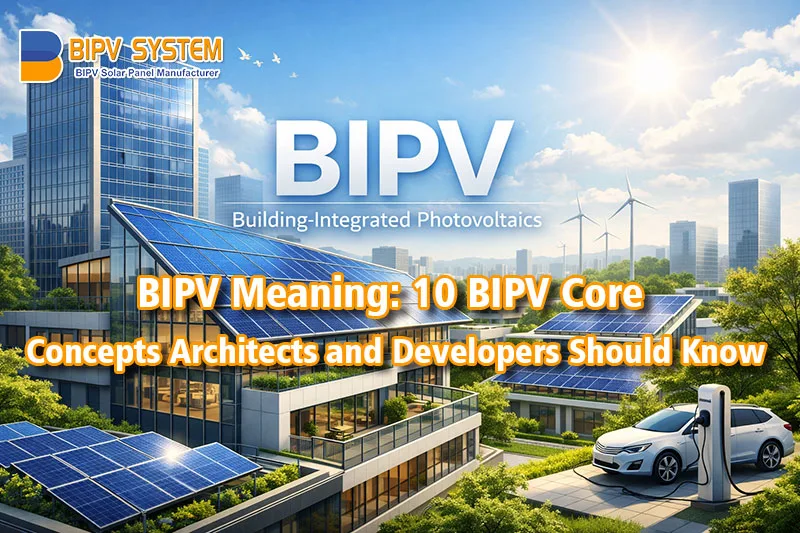
In simple terms, it means photovoltaic systems that are part of the building itself, not something added afterward.
In BIPV, photovoltaic elements are building components first—roofing, facade panels, curtain walls—and energy systems second.
That sounds subtle, but it completely changes:
how systems are designed
how risks are allocated
how performance is evaluated
If a BIPV module fails as a building material, power output becomes irrelevant.
2. BIPV Is Not “Mounted On” — It Is “Designed In”
Traditional solar systems are mounted onto buildings.
BIPV is designed into the building envelope.
This is a core distinction behind the meaning of BIPV technology.
It requires coordination between:
architectural design
structural engineering
electrical planning
In practice, BIPV decisions happen earlier than traditional PV decisions.
3. The BIPV Meaning Is System-Level Integration
Many people focus only on the panel.
But BIPV, by definition, is a system, not a single product.
A complete BIPV system includes:
BIPV modules
mounting and support structures
waterproofing and drainage logic
electrical integration
Understanding the bipv meaning means thinking beyond hardware.
4. BIPV Is Architecture-Driven, Not Efficiency-Driven
Here’s a truth that surprises many developers:
BIPV is rarely chosen for maximum efficiency per square meter.
Instead, BIPV decisions are driven by:
facade orientation
visual consistency
multifunctional value
The meaning of BIPV lies in combined value, not peak output.
5. BIPV Modules Replace Traditional Materials
One practical way to understand BIPV meaning is to ask:
“What building material does this replace?”
Roof tiles? Glass panels? Cladding?
If the PV element replaces nothing, it’s probably not BIPV.
This replacement logic is central to cost, compliance, and approval.
6. BIPV Performance Is Evaluated Differently
With traditional PV, performance is mostly about energy yield.
With BIPV, performance also includes:
weather resistance
thermal behavior
durability
maintenance access
The meaning of BIPV expands performance metrics beyond kilowatt-hours.
7. BIPV Requires Customization by Nature
Standardization works well for rooftop solar.
BIPV is different.
Because buildings differ in:
size
geometry
codes
aesthetics
Most BIPV solutions involve custom or semi-custom design.
Understanding this helps set realistic expectations early.
8. BIPV Is a Long-Term Building Decision
Another overlooked aspect of bipv meaning is lifecycle thinking.
BIPV systems are expected to last:
As long as the building envelope
Often 25–30 years or more
This influences supplier selection, detailing quality, and system redundancy.
9. BIPV Blurs the Line Between Energy and Architecture
From a design perspective, BIPV lives in the grey zone between:
Architecture
Engineering
Energy planning
That’s why successful BIPV projects usually involve cross-disciplinary collaboration from the start.
The BIPV meaning is as much organizational as it is technical.
10. BIPV Meaning Ultimately Depends on Project Intent
Finally, here’s something experience teaches you.
For some projects, BIPV means:
sustainability branding
For some projects, BIPV means:
compliance with energy regulations
And for some:
long-term asset value
There is no single “correct” BIPV definition—only a contextual one.
A Thought Before You Move On
If you searched for “BIPV meaning”, chances are you’re at the very beginning of a decision process.
That’s a good place to be.
Because once the meaning is clear,
technical choices, system types, and suppliers start to make a lot more sense.
And in future articles, we’ll move from meaning to making BIPV work—step by step, without skipping the hard parts.