When people search for BIPV durability, they are usually not asking a cosmetic question. They are asking a risk question.
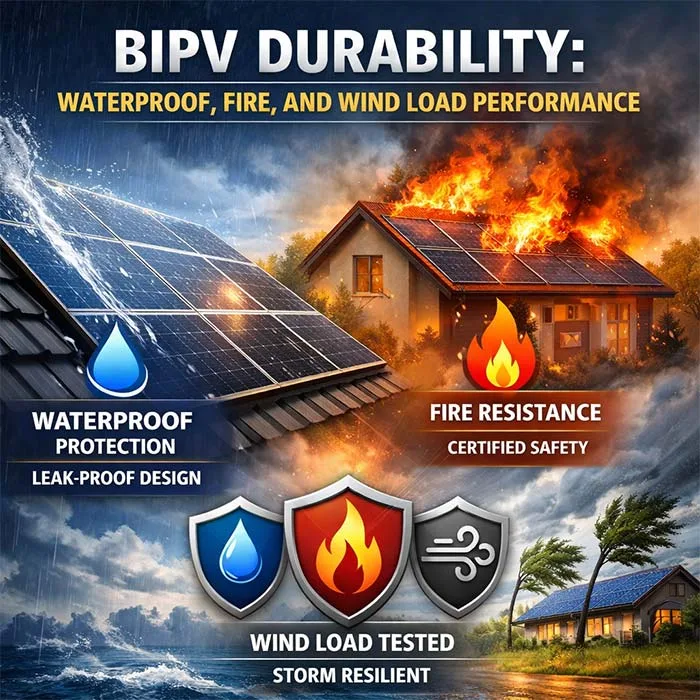
Can a BIPV system work as part of the building envelope without becoming the weak point of the project? Can it resist water intrusion, meet fire safety expectations, and stay reliable under wind pressure and long-term weather exposure? And just as importantly, does it still make sense when compared with conventional cladding plus standard rooftop PV?
The practical answer is this: BIPV durability is not defined by one panel spec or one lab result. It is defined by how well the system performs as a building material and an energy-generating assembly at the same time. That is why waterproofing, fire behavior, and wind load resistance matter more than headline efficiency in many projects.
For developers, architects, industrial owners, and design institutes, the real issue is not whether BIPV can generate power. It can. The real issue is whether it can do so while meeting the structural, safety, and envelope-performance expectations that conventional façade, roof, or canopy materials are already expected to meet.
Table of Contents
Why BIPV Durability Matters More Than Many Buyers First Assume
A conventional PV module sits on top of a completed building surface. A BIPV system often replaces part of that surface.
That difference changes everything.
When BIPV is integrated into a façade, roof, skylight, canopy, or other envelope element, it is no longer judged only as a power product. It is judged as part of the building. That means its value depends on whether it can simultaneously support:
- weather protection
- structural stability
- fire safety strategy
- long-term service life
- architectural integration
- maintainable energy output
This is why bipv testing should never be reduced to electrical performance alone. In many real projects, the winning system is not the one with the highest nominal output. It is the one that reduces envelope risk, avoids redesign, simplifies compliance discussions, and performs reliably over time.
A durable BIPV system makes more sense than a cheaper but less integrated alternative when the project is trying to achieve several goals at once: replace external materials, generate electricity, control lifecycle cost, and maintain a clean architectural expression.
What “BIPV Durability” Actually Means in Project Terms
In specification documents, durability is often discussed in fragmented categories. In real projects, those categories interact.
For BIPV, durability usually means the system can maintain acceptable performance under long-term exposure while still functioning as part of the building assembly. That includes:
Resistance to water ingress
This is critical because water problems do not stay local. Once water penetrates the system or supporting interfaces, the issue quickly expands into corrosion, insulation damage, interior leakage, mold risk, and reputational cost.
Fire behavior within the assembly
A BIPV element must be evaluated not only for its own material behavior but also for how it interacts with the surrounding roof or façade system. Fire safety is always an assembly-level issue, not just a panel-level talking point.
Wind load resistance and mechanical stability
BIPV must withstand both positive and negative pressure, local uplift, repeated stress, and edge-zone exposure. This matters especially on tall façades, industrial roofs, and sites with severe weather conditions.
Long-term environmental exposure
UV, thermal cycling, humidity, freeze-thaw conditions, temperature swings, pollution, and salt-laden air can all degrade materials and interfaces over time. A system that looks acceptable in a brochure may fail in the field if these realities are ignored.
Functional durability as a dual-purpose material
This is one of the most overlooked points. A BIPV product is not durable just because the solar cells survive. It must also remain serviceable as cladding, roof skin, or weather barrier. If it still generates power but loses envelope integrity, the project has still failed.
Waterproofing: The First Real Test of Whether BIPV Works as a Building Material
In most building projects, water is the most immediate and unforgiving failure mode. That is why waterproofing deserves more attention than it usually gets in early-stage BIPV discussions.
A BIPV system installed on a roof or façade is exposed to far more than direct rainfall. Real water risk includes:
- capillary action at joints
- wind-driven rain
- standing water in poorly drained areas
- movement at interface points
- sealant aging
- installation tolerance errors
- repeated thermal expansion and contraction
The mistake many teams make is treating BIPV as if the module itself is the only waterproofing concern. In reality, the whole assembly matters: panel joints, framing details, drainage paths, penetrations, flashing logic, mounting points, and the relationship with adjacent materials.
Why waterproofing performance is more important in BIPV than in conventional PV
A standard rooftop PV system usually sits above an already waterproof roof. If the PV module has no weatherproofing function, the building envelope still exists beneath it.
BIPV changes that logic. In many applications, the integrated system is part of the weather skin. That means waterproof failure is not a secondary inconvenience. It is a primary building defect.
This is also where the dual-function material replacement argument becomes real. If BIPV is replacing conventional façade panels, skylight materials, roof sheets, or canopy surfaces, it must take on their weather-resistance role as well. Otherwise, the theoretical material substitution benefit collapses in practice.
What waterproofing testing should help you judge
Testing is useful when it answers project questions, not when it simply produces a certificate list.
From a decision perspective, waterproof-related evaluation should help answer:
- Can the assembly resist water penetration under pressure?
- Does the joint design remain reliable under movement and temperature fluctuation?
- Is drainage managed intentionally, or is the design overly dependent on sealants alone?
- Are critical details robust enough for long-term service, not just initial commissioning?
A system that depends too heavily on perfect installation conditions or excessive site-applied sealing usually carries more long-term risk. A better system is one whose waterproof logic is built into the profile design, overlap logic, channeling strategy, and interface coordination.
Common mistake: focusing only on module sealing
This is a classic misjudgment.
A specifier may confirm that the module itself is laminated and sealed, then assume the waterproof issue is solved. It is not. In most BIPV failures, the problem appears at the system level, not the cell level.
The real difference is this: module integrity protects the product; assembly waterproofing protects the building. Projects need both.
Fire Performance: Why BIPV Safety Must Be Evaluated as a System, Not a Slogan
When buyers ask about bipv safety, fire is usually one of the first hidden concerns behind the question.
That concern is justified. Any building-integrated energy system must be assessed not only for energy contribution, but also for how it behaves in a fire event, how it affects flame spread risk, and how it fits into the broader fire strategy of the building.
The wrong way to think about fire performance is to ask only, “Is the module fire resistant?”
The better question is, “How does this BIPV assembly behave as part of the roof or façade under the project’s actual fire design conditions?”
Why fire performance is more complex in BIPV than in conventional material selection
A conventional façade material is mainly judged as a building product. A conventional PV module is mainly judged as an energy product installed onto a building.
BIPV sits in between. It has to satisfy both worlds.
That means the fire discussion may involve:
- surface spread behavior
- reaction-to-fire characteristics
- roof assembly fire performance
- façade fire propagation risk
- cable routing and electrical isolation
- detailing around penetrations and junctions
- compatibility with local code expectations and project fire engineering
In other words, BIPV fire performance is not a single-parameter issue. It is a coordination issue across architecture, envelope engineering, electrical design, and compliance review.
What good fire-performance thinking looks like
A good project team does not treat fire as a late-stage compliance formality. It addresses it early at the system selection stage.
That means asking:
- Is this BIPV intended for roof, façade, canopy, or skylight use?
- What are the fire expectations for that specific building element?
- Are the backing materials, cavity design, insulation layers, and substructure compatible with the intended fire strategy?
- Will the electrical layout create avoidable risk or complexity in emergency scenarios?
A durable BIPV solution is not just one that survives exposure. It is one that fits into a fire-safe building design without forcing compromise elsewhere.
Common mistake: using “safe” as a vague marketing word
“Safe” is one of the most overused and least useful words in technical content.
For project decisions, safety only matters when it is translated into practical evaluation logic. In BIPV, that means understanding what has actually been assessed, at what level, and in what use context.
A product may sound credible in a brochure but still be a poor choice if the project team has not clarified the intended application, assembly composition, and code pathway. This is why bipv testing should always be tied back to use case, not presented as a detached badge.
Wind Load Resistance: Where Durability Becomes a Structural Issue
For many BIPV applications, wind load is the point where architectural intent meets engineering reality.
This matters even more in:
- high-rise façades
- coastal or typhoon-prone regions
- industrial parks with large roof spans
- corner and edge zones with higher suction forces
- exposed canopies and walkway covers
In these conditions, wind is not just a weather issue. It is a structural design issue.
Why wind load matters differently in BIPV
The usual mistake is to assume that if a module can survive general outdoor use, it is automatically suitable for integrated building applications. That assumption is weak.
In BIPV, wind resistance depends on far more than panel strength. It also depends on:
- fixing method
- support spacing
- frame or frameless edge design
- load transfer path
- rail or substructure design
- joint movement allowance
- local pressure concentrations
- building height and geometry
Compared with conventional rooftop PV, BIPV often has tighter visual integration requirements and a stronger dependency on building-envelope detailing. That can be an advantage aesthetically, but it also means poor structural coordination becomes more expensive to correct later.
What wind load testing should tell you
From a project standpoint, the value of wind-related assessment is not that it proves the product “is strong.” That is too vague to be useful.
It should help you judge:
- whether the system is suitable for the intended installation zone
- whether fixation and support details are realistic for the project
- whether the design has margin for severe weather exposure
- whether long-term fatigue, vibration, and movement have been considered
This is especially important if your project is being sold on extreme weather resistance. That claim only has value when it is translated into structural logic, engineering coordination, and verifiable test pathways.
Common mistake: comparing only static panel strength
Static strength alone does not represent full field risk.
Real projects experience repeated loading, thermal movement, installation tolerance variation, edge conditions, and combined envelope stresses. A system may look strong on paper and still create service issues if the connection logic is weak or the project-specific load assumptions are unrealistic.
The better approach is to evaluate the whole installed system, not just the panel in isolation.
Common Misreadings in BIPV Durability Evaluation
A few patterns come up repeatedly when projects run into problems with BIPV performance claims:
Comparing module-level certifications as if they’re equivalent to building-product certifications: IEC 61215 and IEC 61730—the core PV module standards—test for electrical and mechanical safety as components. They don’t test weatherproofing as a primary envelope function, fire performance as cladding, or structural performance as a load-bearing element. A BIPV product certified only to PV module standards is not necessarily certified as a building product. The two need to be treated as separate compliance domains.
Using energy yield data as a proxy for durability: High power output doesn’t correlate with long-term building performance. A module optimized for power density may use thinner laminates, different encapsulant formulations, or lighter frame profiles that affect weatherproofing and structural performance. Treat energy performance and building durability as independent evaluation criteria.
Assuming all “tempered glass” BIPV products are equivalent: Tempered or laminated glass is standard across most BIPV products, but the interlayer type, thickness configuration, and frame-to-glass sealing system vary considerably and have real consequences for fire performance, thermal cycling behavior, and impact resistance. Glass type is one variable in a larger system.
Over-relying on datasheet values without application-specific context: A datasheet operating temperature range doesn’t tell you how a product performs on a south-facing roof in a hot climate over 25 years. Wind load ratings tested at a fixed support spacing don’t tell you how the system performs at your project’s actual fixing layout. Ask for the test methodology, not just the result.
What Genuine Durability Looks Like in Practice
A BIPV product designed to function as a primary building envelope element—rather than an added-on energy layer—typically demonstrates durability through a combination of:
Material substitution logic: When BIPV replaces conventional roofing or cladding, the durability benchmark is the material it’s replacing. If a standing-seam metal roof in the same application has a 40-year expected service life, the BIPV system should be evaluated against a comparable standard—not against a conventional PV module’s 25-year warranty.
System-level testing, not component-level testing: Waterproofing, fire, and wind performance are properties of the installed assembly—the panel, the frame, the fixings, the backing structure, and the junction details. Component test data is necessary but not sufficient. Look for evidence of testing on representative assemblies.
Long-term warranty structure: A credible durability claim is backed by a warranty structure that covers performance at the building level, not just power output degradation. The power output warranty tells you about the photovoltaic performance; a separate product warranty covering waterproofing integrity and structural performance tells you about the building function.
Documented performance in comparable climates: The most reliable evidence of durability is how similar systems have performed in similar conditions over time. This is difficult to assess from a datasheet but is worth investigating through reference project documentation, third-party test reports, or installation records in comparable climate zones.
Common Misunderstandings About BIPV Safety and Durability
“If it generates power efficiently, it must be a good BIPV product”
Not necessarily.
Efficiency matters, but integrated building use puts equal or greater weight on envelope compatibility, durability, safety, and installation logic. A higher-output product that creates envelope risk is often the worse choice.
“Testing is mainly a sales document issue”
Wrong.
Testing only becomes valuable when it reduces project uncertainty. For BIPV, that means understanding whether the system is credible for the actual application, not just whether documents exist.
“BIPV is just PV with better appearance”
That is far too simplistic.
The real difference is integration. BIPV must behave like part of the building. That changes how it should be designed, specified, installed, and evaluated.
“Initial price tells us whether the solution makes sense”
Again, incomplete.
For integrated applications, the correct comparison is usually between BIPV and the combined cost of conventional envelope materials plus separate PV strategy, plus the coordination and maintenance implications of each path.
Who Should Prioritize Durability Most in a BIPV Project
Durability matters in every project, but some stakeholders should care even more.
Developers and asset owners
They carry the long-term cost of envelope failure, maintenance complexity, and performance disputes. For them, durability is an asset-risk issue.
Architects and design institutes
They need systems that preserve design intent without creating detailing weakness. For them, durability is a compatibility and specification issue.
Industrial owners and park operators
They often manage large roof areas, exposed conditions, and long operating cycles. For them, durability is a resilience and lifecycle-cost issue.
Green building project teams
They need solutions that support sustainability claims without undermining practical building performance. For them, durability is the bridge between energy ambition and real-world execution.
When a More Advanced BIPV System Makes Strategic Sense
A technically stronger BIPV system tends to make more sense when the project values more than first-cost comparison.
That usually includes projects where:
- conventional material replacement is meaningful
- the owner wants long-term operating value
- severe weather is a real design condition
- architectural integration matters
- design teams need measurable technical credibility
- envelope performance cannot be treated as secondary
In these cases, a system with quantifiable technical performance, stronger weather resistance logic, and better integration discipline often creates more project value than a nominally cheaper alternative.
That does not mean every project needs the most advanced solution. It means the selection should match the project’s risk profile, service life expectations, and integration objectives.
Conclusion: The Best BIPV Durability Strategy Is to Evaluate It Like a Building System
The clearest way to understand bipv durability is this: it is not just about whether a solar product survives outdoors. It is about whether an integrated solar building system can continue to perform as part of the envelope under real service conditions.
That is why waterproofing, fire behavior, and wind load resistance are not secondary checks. They are core decision factors.
If a BIPV solution is meant to replace conventional building materials, it must be judged by building-material standards of thinking: weatherproofing logic, fire suitability, structural reliability, maintenance implications, and long-term asset value. The power-generation function matters, but it is only one part of the decision.
For serious projects, the most useful question is not “Does this BIPV product look advanced?”
It is “Can this system perform credibly as both an energy asset and a building component over time?”
That is the durability standard that actually matters.