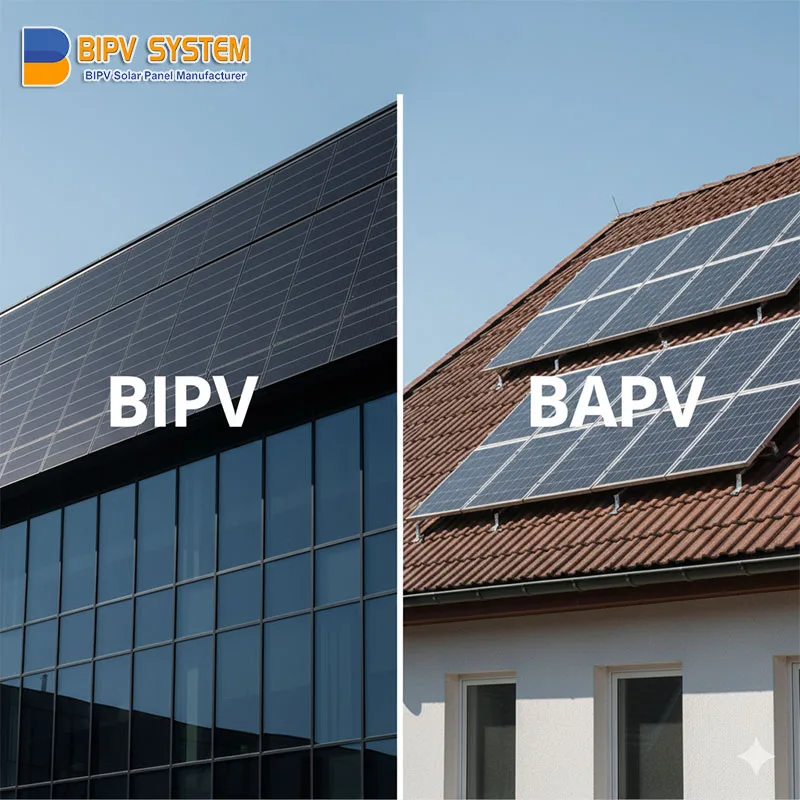
The current solar construction market is primarily divided into two camps: BIPV (Building-Integrated Photovoltaics) and BAPV (Building-Applied Photovoltaics). While both technologies generate electricity, they differ fundamentally in design logic, structural function, and long-term return on investment (ROI).
Understanding the core differences between BIPV and BAPV is not just a technical choice; it is a strategic decision regarding the future of architecture, asset valuation, and true sustainability. This article provides an ultimate comparison of BIPV and BAPV, analyzing why building integration is the inevitable trend.
Table of Contents
The Core Definitions: BIPV and BAPV
The first step in understanding the BIPV and BAPV debate is to look at their relationship with the building itself.
BIPV (Building-Integrated Photovoltaics)
BIPV follows the “Logic of Integration.” It treats photovoltaic components as an inseparable part of the building itself. These components are used to directly replace traditional building materials (such as roof tiles, curtain wall glass, facade cladding, or shading louvers). The essence of BIPV is a “multi-functional building material” that simultaneously performs the roles of power generation, weather protection, structural support, and aesthetics.
BAPV (Building-Applied Photovoltaics)
BAPV follows the “Logic of Addition.” It refers to conventional solar power systems installed onto existing building envelopes (primarily rooftops) after construction. It does not replace any building materials; its function is singular—solely to generate power. The common rooftop solar racking system is a typical example of BAPV.
In short: BAPV is the building’s “additional equipment,” while BIPV is the building’s “skin and organs.” This fundamental difference in attributes leads to a series of critical distinctions.
BIPV and BAPV: A Deep Dive Comparison
To help you make an intuitive judgment, we have summarized the performance indicators for BIPV and BAPV in the current 2025 market landscape.
| Feature | BIPV (Building-Integrated Photovoltaics) | BAPV (Building-Attached Photovoltaics) |
|---|---|---|
| Core Functions | Electricity generation + building envelope (dual function) | Power generation function only. |
| Installation method | Integrated directly as a building component. | Use brackets to mount it onto the existing structure. |
| Aesthetic effect | Seamless aesthetics, with customizable colors and transparency. | Visually striking, but also feels heavy and somewhat jarring. |
| Waterproof performance | Structural waterproofing, as the building's skin. | Sealing treatment depending on the installation location. |
| Fire resistance rating | Extremely high (typically double-glazed + PVB, Class A) | Lower (plastic base plate, higher risk) |
| ROI | 25-30% faster payback period (including material substitution costs) | Relying solely on electricity generation revenue, the payback period is relatively long. |
Why is BIPV Replacing BAPV?
1. Economic Analysis: TCO vs. Initial Cost
In the BIPV vs BAPV discussion, people often limit themselves to the initial “cost per watt,” which is a one-sided view.
BAPV: The cost structure is transparent, consisting of PV modules, racking, inverters, labor, and auxiliary materials. Its economic model is relatively simple, focusing mainly on generation revenue versus investment cost.
BIPV: This requires a “Net Incremental Cost” or “Total Cost of Ownership (TCO)” analysis. For example, installing a BIPV solar facade may have a higher total price, but it saves the cost of purchasing and installing the natural stone, aluminum panels, or standard glass that would have otherwise been used.
Although the initial procurement cost of BIPV is typically 10%-15% higher than traditional modules, its true economy lies in “Material Substitution.” Because BIPV directly replaces expensive curtain wall glass or high-end roofing materials, the total building cost is often more competitive. Research shows that when considering material savings and energy generation over a 30-year lifecycle, BIPV systems can achieve an Internal Rate of Return (IRR) of 12%-21.6%, far exceeding the 8%-12% of BAPV.
2. Aesthetics and Design Freedom
This is the most visible difference between BIPV and BAPV, and often the deciding factor for architects.
BAPV: Uses standardized dark blue or black modules with fixed dimensions. Architects often have to “find a way to accommodate” these panels after the design is done, or accept the disruption to the building’s facade.
BIPV: Acts as a customizable “construction material.” Color (simulating stone, metal, or stained glass), transparency (from 0% to over 60%), size, and shape can all be tailored to design needs. It shifts solar from a “design constraint” to a “design tool,” enabling futuristic and expressive architecture.
3. Performance and Reliability
BAPV: Focuses on photovoltaic performance (efficiency, degradation). The interface between the racking system and the roof is often a weak point for waterproofing and wind uplift resistance.
BIPV: Beyond power generation, it must first meet rigorous building material standards: structural mechanics, fire rating (e.g., Class A non-combustible), water tightness, air tightness, impact resistance, and weatherability. A piece of BIPV glass is a safety building material first, and a power generator second. This means its testing standards and certification systems are far more complex and strict than those for BAPV.
4. Policy and Future Adaptability
Starting in 2025, building energy efficiency standards in the EU and US (such as California’s Title 24) have tightened significantly. Because BIPV is part of the building structure, it must meet stricter fire and wind pressure standards (like EN 50583).
In countries like Italy, 2025 fire safety guidelines classify BIPV into a higher safety category, significantly increasing compliance costs for BAPV on new public buildings. Policies are no longer just asking for “solar presence”; they are encouraging buildings to become energy producers themselves. Therefore, while BAPV may serve as a transitional solution, BIPV is the mainstream solution for achieving “Net Zero Energy Buildings.”
BIPV and BAPV (FAQ)
Is BIPV efficiency lower than BAPV?
Not necessarily. While traditional views held that BIPV sacrificed efficiency for aesthetics, high-efficiency crystalline silicon BIPV modules now rival standard modules. Even for semi-transparent or colored BIPV, while absolute efficiency per square meter might be lower, the combined value of energy generation plus material functionality offers a higher overall benefit.
For existing buildings, should I choose BIPV or BAPV?
For simple retrofits where the roof is in good condition (less than 5-10 years old), BAPV is usually the more economic and faster choice. However, if you are facing a roof replacement or facade renovation, BIPV is the smarter choice, allowing you to achieve both renovation and power generation goals in a single construction project.
Since BIPV is the future, will BAPV be eliminated?
BIPV and BAPV will coexist for a long time, but their applications will diverge. BAPV will remain strong in cost-sensitive industrial rooftops and simple retrofits. However, BIPV will become the standard for new construction, iconic public buildings, and high-end commercial real estate. The trend is clear: BIPV’s market share is set for rapid growth.
Conclusion: Why BIPV is the Future Trend
The choice of BIPV vs BAPV is more than just an installation method; it represents a paradigm shift from buildings as “Energy Consumers” to “Energy Producers.”
With increasing policy mandates and maturing technology, the concepts of “Integrated Design” and “Lifecycle Value” represented by BIPV align perfectly with the future of construction. Building-Integrated Photovoltaics (BIPV) is destined to become the essential DNA of green architecture.