If you are considering solar energy for your building, you’ve likely heard the term BIPV (Building Integrated Photovoltaics). Unlike traditional solar panels that are simply “mounted on” a roof, BIPV products—like solar roof tiles or solar facades—are the roof itself.
But how exactly does this system connect to your building’s electrical network? Is it different from a standard solar setup?
BIPV System Diagram is a visual representation that illustrates how solar integrated building materials… It maps out the connection between the photovoltaic generating units… Key Takeaway: The main difference between a BIPV System Diagram and a standard solar diagram is the source…
In this guide, we will break down the BIPV system diagram to help you understand the energy flow, the key components, and how BIPVSYSTEM turns complex technology into a seamless architectural solution.
Table of Contents
What is a BIPV System Diagram?
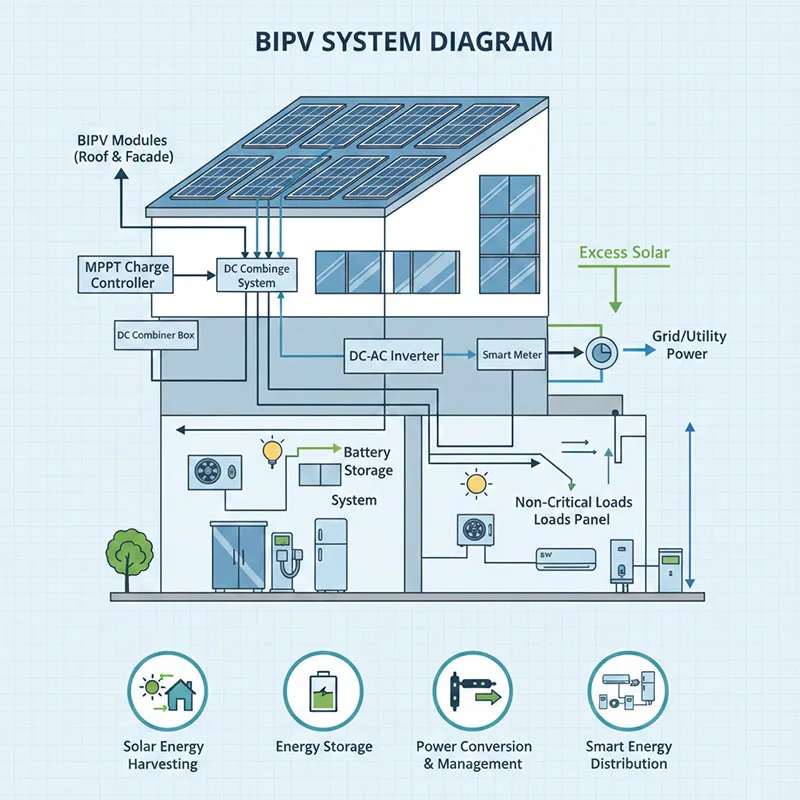
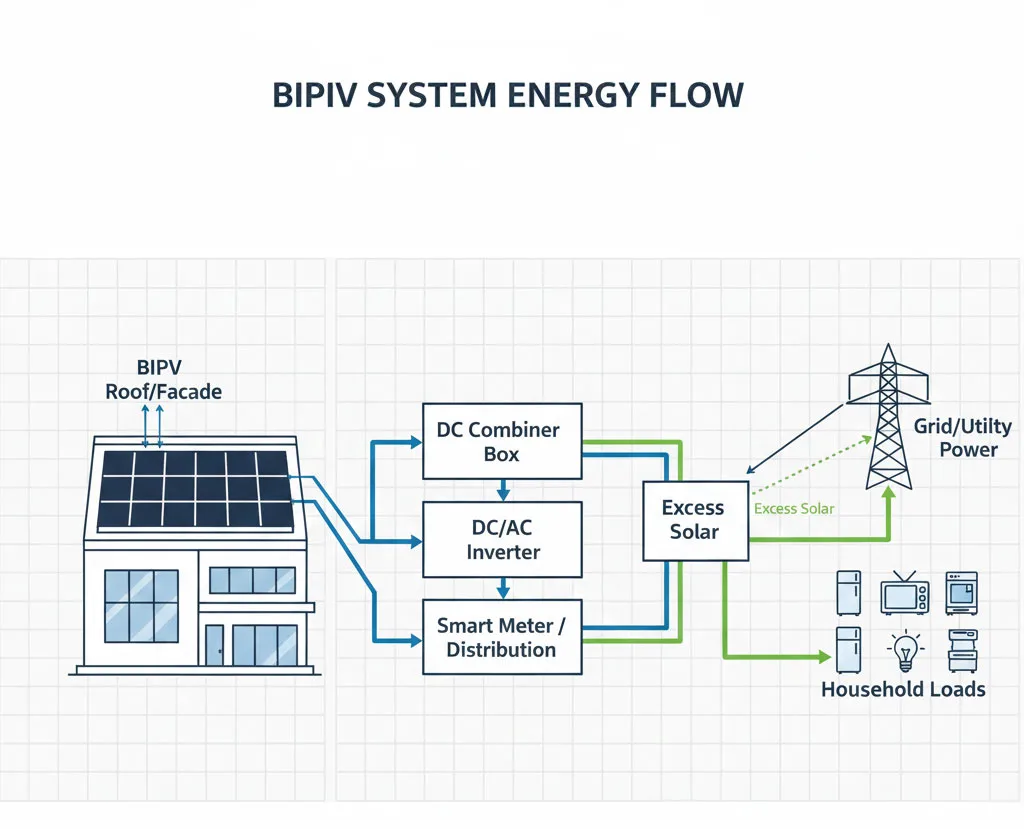
BIPV system diagram is a visual representation that illustrates how solar integrated building materials (such as solar shingles or facades) capture sunlight, convert it into electricity, and distribute it to your home or the power grid. It maps out the connection between the photovoltaic generating units, the inverter, the battery storage, and the main electrical panel.
Key Takeaway: The main difference between a BIPV diagram and a standard solar diagram is the source. In BIPV, the “source” is your building’s envelope (roof or wall), performing two functions: weather protection and power generation.
Visualizing the Workflow: Step-by-Step
To understand the system, imagine following a beam of sunlight as it hits your building. Here is the standard workflow of a grid-tied BIPV system:
1. The Generator: BIPV Modules (DC Power)
It starts at the surface. Whether it is our BIPV Roof System (especially our popular solar tiles) or our BIPV Facade System (for commercial projects), the integrated modules absorb sunlight.
Function: Unlike standard tiles that just shed water, BIPV tiles contain photovoltaic cells.
Output: They produce Direct Current (DC) electricity. At this stage, the voltage is variable depending on the sunlight intensity.
2. The Brain: The Inverter
The DC electricity travels through hidden wiring (safely tucked under the BIPV structure) to the Inverter. This conversion process is key to every BIPV Diagram.
The Conversion: Your home appliances run on Alternating Current (AC). The inverter’s job is to convert the raw DC power into usable AC power.
Optimization: In modern BIPV systems, we often use optimizers or micro-inverters to ensure that if one part of the roof is shaded, the rest of the system keeps generating power efficiently.
3. The Distribution: Electrical Panel
The AC electricity moves to your building’s main switchboard (Breaker Panel). Here, the energy has two paths:
Self-Consumption: It goes directly to power your lights, HVAC, and appliances.
Grid Export: If you are generating more power than you need, the excess flows through a bi-directional meter back to the utility grid (often earning you credits via Net Metering).
Why BIPV System Design Matters?
You might think, “Is this just the same as regular solar?” Electrically, yes, but structurally, it is very different.
When you look at a BIPV installation diagram, you aren’t just looking at wiring; a proper BIPV System Schematic must account for how the cables penetrate.
Waterproofing Integrity: A proper BIPV diagram must account for how the cables penetrate the building envelope without causing leaks. At bipvsystem.com, our designs integrate unique drainage channels to ensure 100% water tightness.
Thermal Management: BIPV materials form the skin of the building. Our diagrams consider ventilation gaps (especially in facades) to cool the building and improve module efficiency.
Aesthetics: The wiring in a BIPV system is designed to be invisible. We ensure that the transition from the solar tiles to the inverter is hidden, maintaining the architectural beauty of your property.
FAQ: Common Questions About BIPV Systems
Do I need a special electrician for BIPV?
Generally, any certified solar installer or electrician can handle the electrical side (inverter and grid connection). However, the installation of the BIPV tiles usually requires roofers familiar with our modular interlocking system.
Can a BIPV system work off-grid?
Yes. As shown in the BIPV System Diagram,, you can add a battery storage unit before the main panel. This allows you to store energy for use at night or during power outages, making your building energy-independent.
Is the wiring safe under the tiles?
Absolutely. Our BIPV systems use marine-grade, double-insulated cables and connectors (MC4 compatible) designed to withstand heat, moisture, and aging for over 25 years.
Get Your Custom BIPV Solution
Reading a diagram is one thing; designing one for your specific project is another.
Don’t let the technical details overwhelm you. Contact us today, and let our engineers design the perfect BIPV System Diagram for your project. into the building materials. This is where we come in.
At BIPVSYSTEM, we are not just a manufacturer; we are your system solution provider.
We analyze your project: We look at your roof angle, orientation, and energy needs.
We design the system: We provide the wiring diagrams, structural node details, and layout designs tailored to your building.
We simplify installation: Our modular design ensures that your local installers can easily follow the plan.
Ready to transform your roof into a power generator? Don’t let the technical details overwhelm you. Contact us today, and let our engineers design the perfect BIPV system diagram for your project.