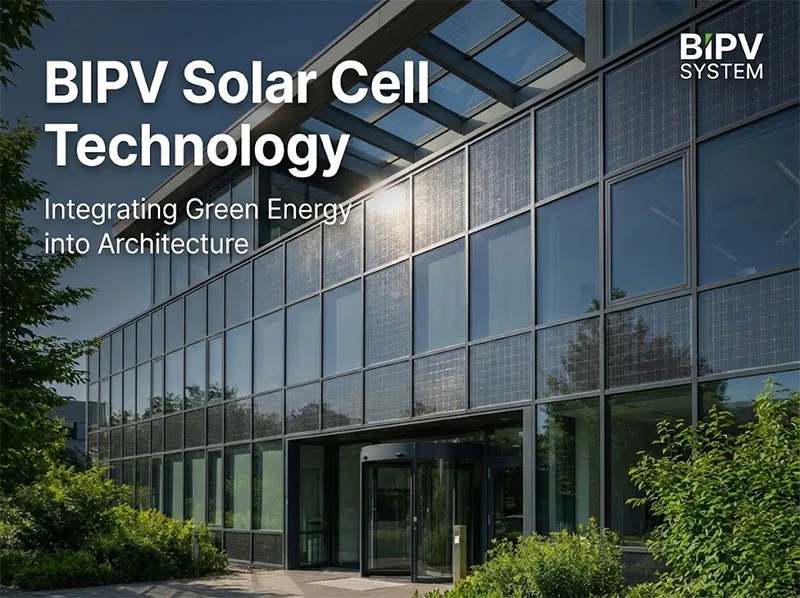
The BIPV solar cell is the “engine” of any Building Integrated Photovoltaic system. Unlike traditional solar panels that are simply mounted on top of a roof, a BIPV solar cell is integrated directly into the building materials, serving a dual purpose: generating electricity and acting as the building envelope. Choosing the right BIPV solar cell technology is crucial for balancing energy efficiency with architectural aesthetics.
This guide breaks down the three main categories of BIPV solar cells—Crystalline Silicon, Thin-Film, and Emerging Technologies—to help you choose the right “engine” for your solar roof or facade.
Table of Contents
Quick Summary: The 3 Main Types of BIPV Solar Cell
There are three primary technologies used in BIPV construction today:
Crystalline Silicon (c-Si): The most efficient technology (>20%). Best for rooftops and opaque areas where maximizing power generation is the priority.
Thin-Film (CdTe / CIGS / a-Si): Known for superior aesthetics, low-light performance, and temperature tolerance. Best for building facades, windows, and curved surfaces.
Emerging Tech (Perovskite / OPV): The future of solar. Offers high transparency and tunable colors but is currently transitioning from lab to mass market.
1. Crystalline Silicon (c-Si): The Efficiency Powerhouse
Best For: Solar Roof Tiles, Opaque Spandrels, Skylights (Spaced)
Crystalline silicon is the mature technology found in 90% of standard solar panels. In BIPV, however, we don’t just bolt on a framed panel; we modify the cell integration.
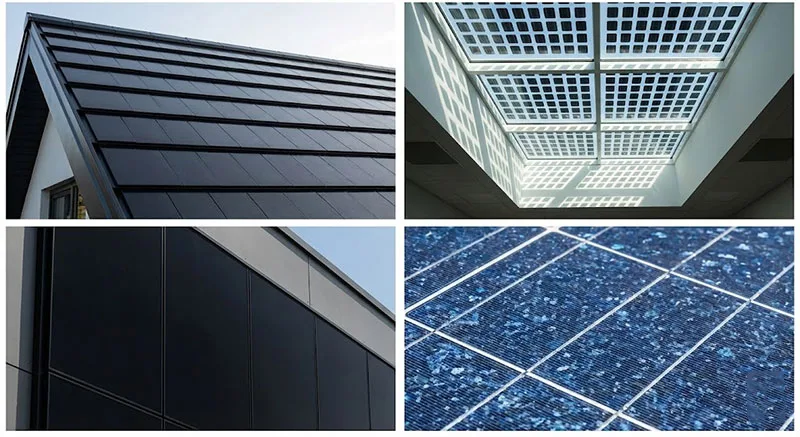
Monocrystalline (Mono-Si)
Appearance: Uniform black or dark blue octagonal cells.
BIPV Application: High-end solar roof tiles (like BIPV Solar Roof)
The “See-Through” Trick: Since silicon cells are opaque (you can’t see through them), BIPV manufacturers create transparency by spacing the cells apart inside double-glazed glass. This creates a “blind” effect—providing shade while letting light pass through the gaps.
The Upgrade: IBC and PERC Technology
For luxury BIPV projects, standard cells often look too “industrial” because of the visible silver grid lines (busbars) on the front.
IBC (Interdigitated Back Contact): Moves all wiring to the back of the cell.
Benefit: The front is pure, uniform black. This is the gold standard for high-end residential BIPV roofs where aesthetics are paramount.
Note on Polycrystalline: You may see “Poly” panels in older articles. They are recognizable by their blue, speckled “mosaic” look. Due to lower efficiency and poor aesthetics, they are rapidly disappearing from the modern BIPV market.
2. Thin-Film BIPV Solar Cell: The Architect’s Choice
Best For: Glass Curtain Walls, Windows, Flexible Surfaces
Thin-film technology involves depositing extremely thin layers of photovoltaic material directly onto glass, metal, or plastic. It is the true “chameleon” of BIPV.
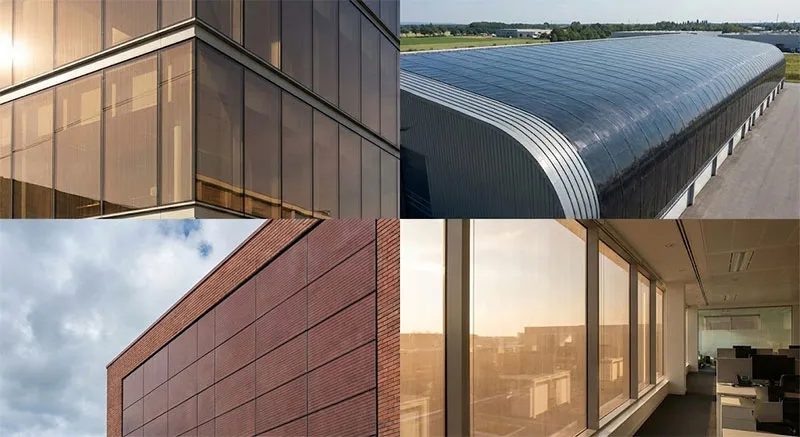
Cadmium Telluride (CdTe)
Transparency: Unlike silicon, CdTe can be made effectively transparent (from 10% to 50%) by laser-etching microscopic lines into the material. The result is a tinted glass look, not a “checkerboard” look.
Temperature Coefficient: It performs significantly better than silicon in hot climates.
Copper Indium Gallium Selenide (CIGS)
Superpower: Flexibility.
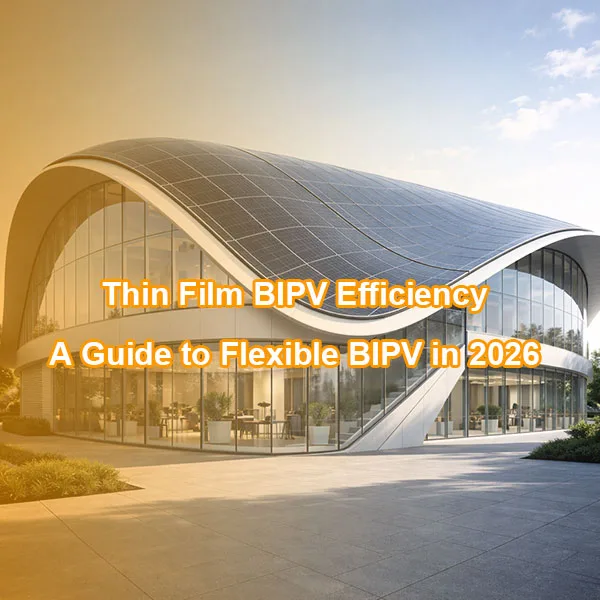
Application: CIGS can be printed on flexible foils, making it ideal for curved roofs, membrane structures, or lightweight warehouse roofs that cannot support heavy glass.
Efficiency: It currently holds the efficiency record among commercial thin-film technologies (up to ~18-19%).
Amorphous Silicon (a-Si)
Pros: Excellent performance in diffuse light (cloudy days or northern facades) and very uniform reddish/brownish appearance.
Cons: Lower efficiency (6-9%) means you need more surface area to generate the same amount of power.
3. Emerging Technologies: The Next Frontier
Best For: High-Transparency Windows, Colorful Facades
Perovskite Solar Cells (PSC)
Perovskite is the buzzword in the solar industry. It promises the efficiency of silicon with the low cost and flexibility of thin-film.
BIPV Potential: They can be tuned to be highly transparent or distinctively colored without losing as much efficiency as traditional technologies.
Challenge: Stability (lifespan) is still being improved for commercial building standards (which require 25+ years).
Organic PV (OPV)
Made from carbon-based materials, OPV is ultra-lightweight and can be produced in various colors. While lower in efficiency, it is exploring niches in transparent energy-generating windows.
The BIPV Solar Cell Ultimate Comparison: Silicon vs. Thin-Film
| Feature | Crystalline Silicon (c-Si) | Thin-Film (CdTe / CIGS) |
|---|---|---|
| Efficiency | High (18% - 23%) | Medium (10% - 18%) |
| Aesthetics | Visible "Cells" (Tech look) | Uniform / Seamless (Glass look) |
| Transparency | Spaced cells (blind effect) | Laser etched (Tinted glass effect) |
| Low Light Perf. | Good | Excellent (works well in shadow) |
| Heat Tolerance | Loses efficiency in high heat | Retains efficiency in high heat |
| Weight | Heavy (Glass/Glass) | Can be Lightweight/Flexible |
| Best Use Case | Roofs (Max Energy) | Facades / Windows (Max Design) |
Selection Guide: Which BIPV Solar Cell Should You Choose?
Scenario A: The "Power-Hungry" House
Goal: You want to zero out your electricity bill.
Location: Residential Roof.
Verdict: Choose Monocrystalline Silicon (IBC). You have limited roof space, so you need the highest “power density” (watts per square meter).
Scenario B: The Glass Skyscraper
Goal: You want a LEED Platinum certification and a modern look.
Location: Curtain Wall / Facade.
Verdict: Choose CdTe Thin-Film. It offers a uniform appearance, performs better on vertical walls (where heat builds up and partial shading occurs), and provides customizable transparency for indoor visual comfort.
Scenario C: The Curved Stadium
Goal: Lightweight roof integration.
Location: Arched metal roof.
Verdict: Choose Flexible CIGS. It can bond directly to the metal surface without heavy glass or mounting structures.
FAQ about BIPV Solar Cell
What is the most efficient BIPV solar cell?
Currently, Monocrystalline silicon (specifically IBC or PERC technology) is the most efficient BIPV solar cell available, offering efficiency rates between 20% and 24%. However, for low-light conditions, thin-film BIPV solar cells (like CdTe) may perform better.
How long does a BIPV solar cell last?
high-quality BIPV solar cell typically has a lifespan of 25 to 30 years. Most manufacturers offer a performance warranty, guaranteeing that the BIPV solar cell will still produce at least 80% of its original power output after 25 years.
Can BIPV solar cell be transparent?
Yes, certain types of BIPV solar cells, such as Thin-Film (Cadmium Telluride) or emerging Perovskite cells, can be manufactured with varying degrees of transparency. This allows them to be used in windows, skylights, and glass curtain walls.
Which technology is cheaper?
Standard Crystalline Silicon is currently cheaper per watt due to massive global mass production. However, for BIPV, Thin-Film can sometimes be cheaper per square meter of construction material because the manufacturing process is less energy-intensive.
Can I mix technologies?
Yes! A common hybrid strategy is to use high-efficiency Silicon on the roof (where it’s unseen and faces the sun) and aesthetic Thin-Film on the facade (where looks matter).
Ready to renovate your building? Contact us to help you calculate the costs.