Choosing BIPV manufacturers in 2026 means selecting a supplier who can deliver photovoltaics as true building materials—meeting envelope performance (waterproofing/structure/weathering), electrical safety and compliance, and stable project delivery. A top-tier BIPV manufacturer needs more than PV cell know-how; they must understand building mechanics, aesthetics, and fire-performance requirements—so the product can replace stone, aluminum panels, or glass while still delivering reliable power output for 25+ years.
In a world pushing Net Zero Energy Buildings (NZEB) by 2026, the manufacturers you pick—those with deep customization, international certifications, and real engineering support—often decide whether your project is delivered smoothly, increases property value, and clears strict building regulations.
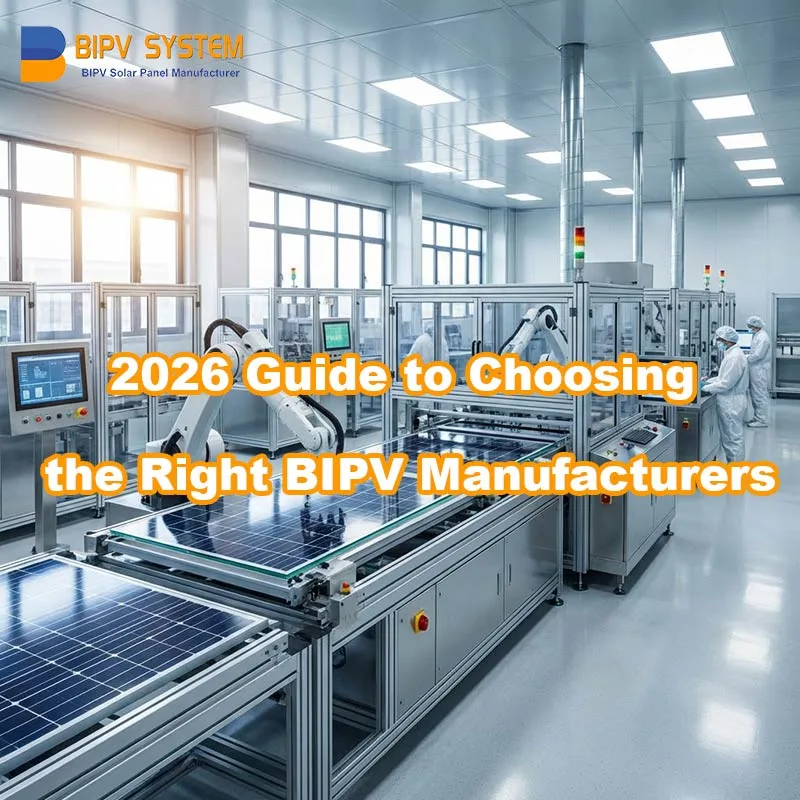
And here’s the uncomfortable truth: BIPV isn’t just an electronic product. It’s the building’s “skin.” If something goes wrong, the repair cost can be ten times the product price. So today, I’m going to share a factory-side, practical view—grounded in international standards—on how to choose the right BIPV manufacturers in 2026.
Table of Contents
The 7 most reliable checkpoints for choosing BIPV manufacturers (2026)
When evaluating BIPV manufacturers, prioritize:
Project-type fit → Standards/certification pathway → Structural & waterproofing detailing capability → Batch consistency & traceability → Delivery & change control → Third-party testing/reports → After-sales boundaries & replaceability/serviceability
A quick decision to find the right manufacturer type
BIPV broadly splits into facade systems (curtain wall, spandrel, glazing, etc.) and roofing systems (tiles, shingles, standing seam, skylights, etc.). Use the questions below to quickly point your selection in the right direction.
Question 1: What’s your most critical goal?
“Architectural facade expression, like real cladding” → Facade / curtain-wall BIPV
“Looks natural on homes or low-rise buildings” → Roof tiles / roof-integrated BIPV
“Daylighting + power (atriums, canopies, walkways)” → BIPV glass / semi-transparent BIPV
Question 2: Who leads the project on the client side?
Facade consultant / curtain-wall contractor → focus on detailing, module grid, installation system, maintenance & replacement
EPC / electrical lead → focus on certification, system integration, monitoring, labeling, cable safety
Question 3: Which market compliance do you need?
U.S. roofing projects: pay close attention to UL 7103 and how it maps to building codes/NEC expectations
International pathway: align early with the IEC 63092 (module/system) framework
The 4 selection standards I recommend for BIPV manufacturers (2026)
1. Standards & certifications: don’t accept “we comply”—ask for “certificate + scope”
IEC 63092-1/2: a key reference framework that treats BIPV as a building product/system
UL 7103 (roofing category, especially for U.S. projects): UL explains listing/marking expectations and scope clearly
Third-party safety evaluation coverage: UL pathways commonly include electrical safety, temperature rise, mechanical load, wind, impact, durability, and fire-related aspects
Certification isn’t paperwork—it’s your leverage during approvals, inspections, insurance discussions, and those painful after-sales disputes no one wants.
2. Building-envelope capability: detailing, drainage, waterproofing, thermal movement—this is the real “make or break”
The IEA PVPS BIPV technical guidance emphasizes structured, engineering-driven implementation: performance requirements, design considerations, real-world application, and availability.
- How do you handle edges/corners/terminations?
- What’s the drainage path? What happens in extreme weather?
- How do you replace a single module later—does it damage the envelope layer?
3. Batch consistency & traceability: a pretty sample doesn’t mean a buildable facade
You’re not buying “one good-looking BIPV panel.” You’re buying an entire building where color, joints, and delivery consistency must match.
Ask BIPV manufacturers to provide:
- Color tolerance logic and inspection criteria
- Nameplate/serial traceability method
- O&M-level records requirements
4. Project experience isn’t “we have cases”—it’s “we have the same type of case”
BIPV experience must match your system type. Facade and roofing are fundamentally different delivery worlds.
Ask:
Have you delivered a system in the same category as mine (facade vs roof vs glass vs canopy)?
Can you show on-site photos, detailing drawings, and acceptance documents (often far more meaningful than renderings)?
✅ Simplified comparison table: what “capability” you actually need from BIPV manufacturers
| System you need | Critical capability focus | What to request from manufacturers | Most common failure |
|---|---|---|---|
| Facade / curtain-wall BIPV | Detailing system, module grid rhythm, waterproofing & drainage, replaceability | Detail library, mock-up plan, installation manual, acceptance/inspection docs | Treating facade like a “solar array” and improvising on site |
| Roof tiles / roof-integrated BIPV | Roof-system compatibility, waterproofing, wind uplift, certification pathway | Roofing assembly details, third-party tests/certificates, construction details | “Looks like tiles” but fails at terminations and drainage |
| BIPV glass / semi-transparent | Transparency/pattern control, cable routing, install method + service strategy | Transparency concept notes, node details, maintenance plan | Focusing on aesthetics but ignoring replacement and cable access |
| Canopies / walkways / shading | Structural interfaces, drainage, glare risk, safe access & O&M | Interface drawings, drainage design, access/maintenance pathway | Designing for output but forgetting maintenance access |
3 things BIPVSYSTEM helps you prevent early
Many procurement teams get stuck on: “How do I prove this manufacturer is truly reliable?”
Here are the three “must-make-it-mandatory” items I recommend:
Ask for a “system-level delivery package” first
Not just module specs—include installation method, detailing, labeling, and maintenance strategy. Don’t let the site gamble with experience.
Require a mock-up (especially for facade BIPV)
Because issues like detailing, drainage, and replaceability rarely show up on paper. A mock-up saves more money than it costs.
For U.S. roofing, focus on UL 7103 listing/marking expectations; internationally, align with IEC 63092 framework early.
Honestly, once you write these into your procurement documents, suppliers split fast:systematic manufacturers feel comfortable; vague ones get fuzzy. That’s your filter.
FAQ
What’s the first step when choosing BIPV manufacturers?
Confirm your system type (facade/roof/glass/canopy) before selecting suppliers, because each type requires different engineering and delivery capability.
Why must BIPV manufacturers understand both building and electrical requirements?
Because BIPV sits within the building envelope. It must meet waterproofing/structure/weathering needs and electrical safety/compliance at the same time.
What should I pay special attention to for U.S. projects?
For roofing products, look closely at UL 7103 listing/marking expectations and how they map to code/NEC requirements in practice.
Why do you strongly recommend a mock-up?
Because detailing, drainage paths, and maintenance replacement risks are hard to validate on paper; mock-ups expose issues early and reduce rework.
How do I judge whether a supplier can deliver at scale?
Review batch consistency controls, traceability/labeling, system documentation packs, and acceptance materials from the same system type.
Recommended reading
Would you like a copy of our “2026 Manufacturer Audit Checklist“? It’s the same one we use to vet our own production lines.