The BIPV Global market has entered a phase of scaled growth in 2026. According to BIPV global policy developments, Building-Integrated Photovoltaics is no longer merely a component added onto rooftops; it is becoming a core building material that combines power generation, thermal insulation, and architectural aesthetics. The global market size is expected to exceed USD 28 billion in 2026. As mandatory policies take effect across China, Europe, and the United States—the three major markets—BIPV is driving high-energy-consuming buildings worldwide toward transformation into zero-energy assets, becoming a key technological pathway to achieve carbon neutrality goals.
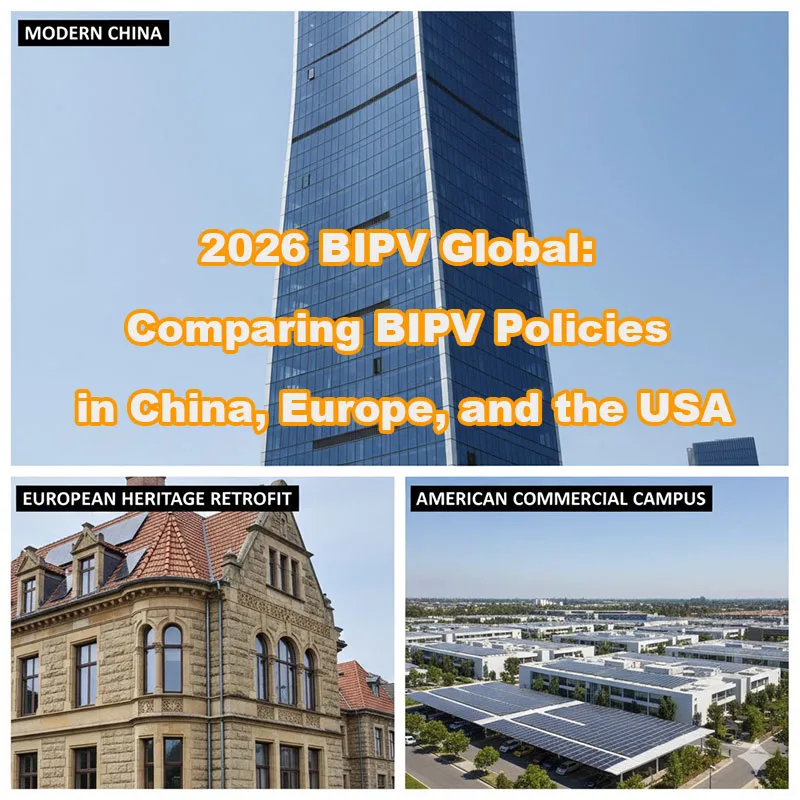
A few years ago, we might still have needed to explain to customers why BIPV’s “high premium” was reasonable. But by 2026, if you design a commercial building without considering BIPV-related policies, that building may face regulatory penalties on the very day it is completed. This shift is not only technological progress—it is also a restructuring of BIPV Global policy power.(Further reading: Building-integrated Photovoltaics Market (2024 – 2030))
Table of Contents
2026 BIPV Global Reality: Three Major Markets, Three Different Paths
Quick note: BIPV is a niche segment, and many countries don’t publish a clean “BIPV installed capacity” number. But you can read the trend directly from building codes, mandates, incentives, and procurement behavior.
China: BIPV as an “Engineering Tool” for Building Decarbonization
In China, BIPV is treated less like a consumer product and more like an infrastructure-style solution: standardize it, pilot it, then scale it.
Where deployment is happening
New industrial facilities, public buildings, and residential projects
Strong push for retrofits (adding PV to existing buildings) and improving governance for those upgrades
Policy levers that matter
In March 2024, China’s national authorities released building-sector action planning that explicitly mentions:improving BIPV standards and technical guidelines, promoting pilots, and strengthening management for PV retrofits on existing buildings.
2026 also sits at the transition between the “14th Five-Year Plan” and the next planning cycle. Meanwhile, the national building energy-efficiency and renewable-use code has already become mandatory across the country.
Local incentives
Some regions (e.g., Zhejiang, Beijing, Shanghai) provide per-square-meter subsidies for BIPV projects—often RMB 50–100/m²—on top of broader renewable mechanisms like FiT.
FiT (Feed-in Tariff) is basically “the government sets a purchase price for your electricity,” like a guaranteed rate per kWh.
The feeling you’ll notice in 2026
China’s keywords are: “standards / guidance documents / demonstration projects / industrial & public buildings first.” It’s engineering-led, not purely subsidy-led.
And I’ll be honest—this part surprised me. Last year, when I visited a factory in Guangdong, the BIPV curtain wall cost per square meter had dropped to roughly the level of premium stone cladding. Once price stops being the barrier, policy stops being a “support” and becomes a detonator.
Europe: Regulation-Driven, with EPBD Turning Solar into a Legal Pathway
Europe’s strongest variable is the revised EPBD (Energy Performance of Buildings Directive)—in plain words: the EU’s rulebook for how efficient buildings must be.
The legal timeline that affects 2026 directly
The revised EPBD (EU/2024/1275) entered into force on May 28, 2024
EU member states must transpose it into national law by May 29, 2026
“Transpose” here just means: each country must rewrite the EU directive into its own enforceable local building laws.
“Solar in buildings” becomes a staged requirement
The directive sets a phased pathway (when “applicable/feasible”)—for example:
New non-residential buildings: if building permits are submitted from Jan 1, 2027, solar systems are required
Existing non-residential buildings (>500 m²): from Jan 1, 2028, solar is required when major renovation or permit-triggering roof/system work occurs
New residential buildings: permits from Jan 1, 2030 require solar systems
CBAM effect: carbon cost pushes BIPV onto facades
CBAM (Carbon Border Adjustment Mechanism)—think of it as “carbon-related cost pressure in supply chains”—is pushing many European manufacturers to reduce facility emissions. That’s why we’re seeing more thin-film BIPV showing up on factory facades.
Thin-film BIPV is like “a solar skin”: lighter, often more visually flexible, and easier to integrate into building surfaces.
“Where can we install it without ruining the facade?”
“Can the curtain wall solve energy + aesthetics together?”
That’s exactly where BIPV naturally lands—on the main table, not as an optional add-on.
United States: Incentives First, Mandates Second
The U.S. is more like: “if you do the right thing, we reward you via taxes”—rather than one unified national rule forcing solar into all new buildings.
The core federal engine
The IRA (Inflation Reduction Act) continues to anchor incentives
The ITC (Investment Tax Credit)—commonly 30%—remains a key driver for solar-related projects
ITC is basically “you spend $X, and you can reduce your tax bill by a percentage of that cost.”
The 45Y / 48E transition
From 2025 onward, federal policy increasingly relies on 45Y (Clean Electricity Production Credit) and 48E (Clean Electricity Investment Credit), gradually replacing older PTC/ITC frameworks for qualifying projects.
If those codes sound like alphabet soup: they’re just “the rule numbers” in U.S. tax law that decide who gets credits and how much.
Domestic Content Bonus
If a project meets certain U.S. domestic steel/manufacturing requirements, it may qualify for extra credit (“bonus”) on top of the base incentive.
In real life, this often turns into a sourcing question: “Can we prove enough local content to unlock extra value?”
State-level momentum: Title 24 in California
California’s Title 24 is one of the most influential building energy standards in the U.S. and continues to tighten.
Think of Title 24 as “California’s building energy rulebook”—and California often pulls the rest of the market with it.
I’ll share a small moment: earlier I assumed policy would get stricter in a way that slows imports and slows projects. Then I spoke with local stakeholders and—yeah—I was genuinely confused. Instead of cooling down, many local governments doubled down on BIPV + energy storage discussions because grid resilience became the bigger headline.
2026 Snapshot: What You Must Notice (China vs. Europe vs. U.S.)
| Dimension | China | Europe | United States |
|---|---|---|---|
| Primary driver | Mandatory codes + national action plans | EU directive → national transposition | Tax credits + state codes |
| 2026 “pressure point” | Compliance + standardized deployment | 2026 transposition milestone | Credit rules + state code enforcement |
| Where BIPV fits best | Industrial/public buildings, large envelopes | Facades, dense cities, renovation triggers | High-value envelopes, code-driven states, incentive-optimized projects |
| Biggest buyer question | “Is it code-aligned and buildable?” | “Does it satisfy EPBD path + design?” | “Can we qualify and de-risk incentives?” |
FAQ: Common Questions About 2026 Policies
What is the hard requirement for solar in Europe in 2026?
The EPBD Revision requires all EU member states to finalize their national laws by May 29, 2026. This sets the stage for mandatory solar on new commercial buildings by 2027 and existing ones by 2028.
What is the core policy driving BIPV in the U.S.?
The federal tax credit system is the main driver, specifically the 45Y/48E framework that began in 2025, plus the Domestic Content Bonus for using U.S.-made materials.
What is China’s main tool for pushing BIPV in construction?
China uses a mix of “Action Plans for Carbon Reduction” combined with strict technical guides and pilot programs, moving toward mandatory standards for all new buildings.
At BIPVSYSTEM, we don’t just manufacture products; we help you decode these complex BIPV global policies. Whether you’re looking to stack tax credits in the U.S. or meet strict EPBD standards in Europe, our team has the on-the-ground experience to provide a custom solution.
Would you like a detailed “Regional Policy Compatibility Report” for your specific project location? Let us help you maximize your subsidies.