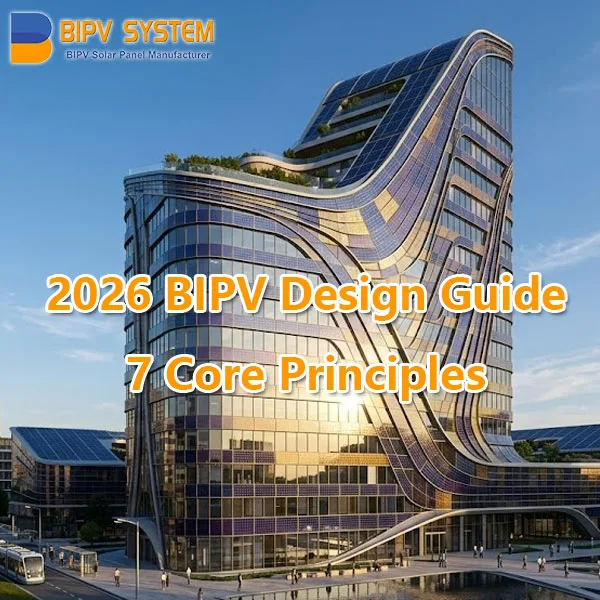
BIPV design refers to a systematic project that integrates photovoltaic power generation technology with the building envelope in multiple dimensions during the early stages of building planning. It requires designers to maximize the power output of photovoltaic cells while meeting the basic functions of building safety, shading, heat insulation and aesthetics.
A successful BIPV design must resolve the conflict between the physical durability of photovoltaic modules as building materials (such as wind pressure resistance and fire resistance) and their electrical stability as power generation equipment (such as shading and thermal management).
By 2026, with advancements in materials science, BIPV design has evolved from simple “facade pasting” to a digital twin integrated design encompassing thermal, light, electrical, and structural simulations, becoming the underlying logic for achieving carbon neutrality in global green buildings.
Table of Contents
Why bipv design in 2026 is different from before
I’ve worked in BIPV for many years, and I’ve seen too many projects discover—during construction—that the PV module format simply “doesn’t fit” the curtain wall system. Honestly, it’s painful every time: not just because of wasted money, but because this could have been prevented on day one of design.
In 2026, bipv design faces a very different environment:
Policy pressure: the EU’s EPBD recast is widely read as strengthening solar-in-buildings requirements and accelerating integration planning for new public/commercial buildings, with residential following later in the timeline. In practice, this pushes BIPV from a “nice-to-have green upgrade” to a compliance-driven baseline for many projects.
Standardization momentum: in February 2026, Fraunhofer ISE and partners released a standardized BIPV planning guide outlining verified integration principles—signaling a shift from “one-off custom solutions” toward a more standardized design system.
Design becomes the core variable: multi-level design review research emphasizes that system performance depends heavily on design choices, while cost remains the biggest barrier to scale.
Put simply: in 2026 you need a more systematic design method to balance compliance, performance, and cost. That’s exactly what this guide is for.
Understand what bipv design really is: not “installing solar on a building”
Understand what bipv design really is: not “installing solar on a building”
The real difference: BIPV vs BAPV
BIPV: PV becomes part of the building envelope and can replace envelope components or integrate within them.
BAPV: PV is installed entirely outside the envelope as an add-on.
From a design logic standpoint:
| Dimension | BAPV (Add-on PV) | BAPV (Add-on PV) |
|---|---|---|
| BAPV (Add-on PV) | Added after envelope design | Coordinated from project initiation |
| Functions | Electricity only | Electricity + envelope functions |
| Structural logic | Independent mounting | Interfaces with building structure |
| Aesthetics | High visual conflict risk | High visual conflict risk |
| Best-fit use cases | Flat roofs, industrial roofs | High-rise facades, complex forms |
In BIPV, building performance is usually the primary requirement—power generation is secondary. Many projects fail because teams keep “peak watts” as the #1 goal and forget waterproofing, thermal performance, and structural realities.
The 7 core principles of bipv design (2026)
Principle 1: Envelope Integrity First
This is the “zero law” of BIPV.
A practical bipv design mindset defines non-negotiables early: envelope integrity, code compliance, safety, and realistic energy expectations. Only after that do you make intentional trade-offs—like accepting slightly lower module efficiency to achieve a better façade expression.
In practice:
- Waterproofing detailing must come before electrical routing
- Thermal expansion allowances must not be squeezed “for neat alignment”
- Ventilation cavity dimensions must not be cut casually to save cost
We see many schemes that look beautifully “clean” in CAD, but once shop drawings begin, waterproof membranes and BIPV framing collide. If discovered during construction, the cost is often 5–10x compared with fixing it during design.
Principle 2: Early Multi-Discipline Collaboration
BIPV is both envelope system and electrical system. You’re not optimizing “yield only”—you’re balancing yield, waterproofing, thermal performance, durability, and appearance in one assembly. If any discipline optimizes in isolation (e.g., choosing module size purely for watts), you can trigger leaks, poor maintainability, or aesthetics failure.
Set up collaboration early:
Architect: facade/roof form, color preference, transparency targets
Structural engineer: added loads, wind pressure, seismic category
Electrical engineer: inverter placement, stringing, grid interconnection
BIPV manufacturer: standard module size library, detail concepts
Facade/waterproofing consultant: sealing system, drainage paths
Principle 3: Site & Orientation Analysis
Not every surface is worth integrating BIPV into—this must be decided early.
A multi-city research result indicates facade PV potential can average a significant share of rooftop potential (with some cities higher), highlighting how underestimated vertical surfaces are—especially in dense environments.
Orientation checklist (early-stage):
- Annual sun-hours for target surfaces (≥800 h/year as a practical feasibility baseline)
- Shadow analysis from nearby buildings/terrain
- Dust/snow accumulation risk (affects real yield)
- Tilt vs local latitude (roof systems)
- Albedo effects on module heat buildup
For facade BIPV, directional response, albedo, shading, ventilation possibility, and soiling must be considered—along with color, transparency, reflectance, or flexibility. Most importantly: do not sacrifice building quality simply to “add solar.”
Principle 4: Technology Route Matching
BIPV offers color, shape, and transparency options—but customization often trades off electrical efficiency. The upside is real: designers can highlight PV as a signature element or hide it inside the material language.
Main routes and best-fit use cases:
Monocrystalline silicon (c-Si)
- Highest efficiency (commonly ~18–22%)
- Best for: roof tiles, opaque facade panels, shading elements
- Limits: color options more constrained
Thin-film (CIGS/CdTe/a-Si)
- Better low-light performance, good in diffuse conditions
- Best for: vertical facades (non-ideal orientations), skylights
- Limits: lower efficiency than c-Si; long-term degradation must be considered
PV glass (semi-transparent modules)
- Transparency typically adjustable ~10–60%
- Best for: glass curtain walls, skylights, canopies, balustrades
- Limits: lower efficiency (often ~8–14%) and higher cost
Perovskite (emerging)
- Perovskite–silicon tandem roadmaps aim for ~30% class efficiency—potentially changing facade economics fundamentally.
Principle 5: Code Compliance & Certifications
This is the most ignored—and most expensive—design step to get wrong.
As envelope components, BIPV systems must resist wind-driven rain and endure rain, thermal stress, and wind load. BIPV products often require both PV product compliance and building-material compliance.
Common frameworks (examples):
International / Europe
- IEC 61215 / IEC 61730 (PV module safety/performance)
- EN 13501 (reaction to fire classification)
- EN 12150 (toughened safety glass)
North America
- UL 61730 / UL 61215
- NFPA 285 (facade fire propagation)
- ASTM E1996 (impact), ASTM E330 (structural performance under wind pressure)
China
- GB/T 29195 (PV building integration)
- JGJ/T 492 (building PV system application standard)
Practical advice: in concept design, confirm with the local AHJ how the BIPV system is categorized—“building material” vs “electrical equipment”—because classification varies and directly impacts approval path and schedule.
Principle 6: Thermal Management & Ventilation Design
This is one of the easiest places to “step on a landmine.”
Different integration types (rear-ventilated facade elements vs embedded variants) can significantly affect both PV performance and long-term visual appearance.
As module temperature rises above ambient, PV efficiency drops (for c-Si often ~0.4–0.5% per °C). Ventilation cavity design matters:
- Rear-ventilated facade: ventilation cavity ≥25 mm (support natural convection)
- Roof-integrated systems: air layer ≥30 mm (reduce heat build-up)
- Glass curtain wall: consider DSF (double-skin facade) thermal stack ventilation logic
Good thermal design improves yield and can reduce HVAC load—this is a key value of BIPV compared with conventional envelopes.
Principle 7: Lifecycle Maintainability
Many teams only ask “Can we install it?” and forget “Can we maintain it?”
High-rise facade BIPV often faces a core issue: accessibility—installation and replacement require scaffolding, gondolas, or platforms.
Pre-design maintenance questions:
- Can a single module be replaced independently without removing neighbors?
- Is the junction box accessible for periodic inspection?
- Does the cleaning path conflict with BMU rails or façade equipment?
- Is there a 25-year replacement plan with reserved interfaces?
We recommend an “O&M tabletop exercise” during design: assume a module fails in year 10—map the steps, tools, and resources needed. This usually reveals issues the drawings don’t show.
Bipv design is easier when you use a “multi-level design” structure
A 2026 research review suggests a multi-level perspective: architecture layer → electrical/system layer → module layer → cell layer. Miss one, and risk grows.
A practical sequence:
Architecture: grid rhythm, joints, glare control, target material performance
Envelope: waterproofing/drainage, air/water tightness, thermal expansion coordination, detail library
Electrical: shading-friendly zoning, stringing/MPPT strategy, cable protection, isolation/labels, SPD/grounding
O&M: replacement routes, spares, fault localization, warranty boundaries
Common bipv design pain points
Pain point 1: Module size doesn’t match curtain wall grid
Root cause: architects lock facade grid first, then try to “fill” with PV modules—only to find no standard size fits.
Solution: adopt “module-size-first logic.” Confirm a standardized module size window early (e.g., 600×1200 to 1500×2400 mm), then derive façade grid constraints from it. Fraunhofer-style guidance emphasizes using early placeholders that can be refined later—and notes that market products already exist for many principles without extreme customization.
Pain point 2: Shadow losses underestimated
Root cause: yield is calculated under ideal sun assumptions; real output drops due to partial shading (parapets, rooftop equipment, nearby buildings).
Solution: use professional tools (PVsyst, PV*Sol) for detailed shading analysis and wiring optimization. Consider string-level or module-level MPPT strategies (MLPE/optimizers) to reduce shading impact.
Pain point 3: Concerns about initial cost and payback
Yes—cost is still the biggest barrier. But the comparison baseline is often wrong:
BIPV cost should be compared against the envelope materials it replaces, not against “doing nothing.”
BIPV glass facade vs standard glass facade + separate rooftop PV
BIPV facade panels vs premium stone/aluminum façade + rooftop PV
When you include substituted material cost, incentives/green certification premiums, and lifecycle electricity savings, the real incremental cost is often much lower than a “bare module price” comparison.
Four major bipv design trends in 2026
AI-assisted design optimization
A Stuttgart University example used generative AI to test ~12,000 configurations in 48 hours, improving yield and reducing glare complaint risk—AI is moving from drafting support to multi-objective optimization for complex forms.
Prefabricated unitized systems
New systems enable factory pre-assembly and pre-wiring, allowing installation from inside the building and reducing scaffolding needs—key for cost and schedule.
Facade BIPV growth
As towers rise and roofs remain limited, facades become the highest-growth BIPV segment over the next decade.
Digital twins & predictive O&M
Machine learning can predict failures weeks ahead (inverter overheating, string faults, delamination), reducing lifecycle OPEX and shifting from reactive to proactive maintenance.
As a BIPV manufacturer, the 3 things I strongly “force” into design reviews
Write the substituted material performance requirements clearly
Don’t specify only power and size. Include weathering/fire/thermal/acoustic requirements—aligned with the idea that BIPV is a building product.
Start with the system-level solution, then select products
IEA PVPS guidance structures the path from site assessment to energy modeling to business/sustainability analysis—because BIPV is a system project.
Use a mock-up to end debates (especially facades)
One mock-up can settle detailing, waterproofing, grid rhythm, color tolerance, installation tolerance, and maintenance route—far better than weeks of meeting-room arguments.
FAQ
How is bipv design different from conventional PV design?
What building types are best suited for bipv design?
What is a typical payback period for bipv design projects?
Which generates more: BIPV facade or BIPV roof?
What certifications are commonly required for BIPV products?
What are the most common bipv design mistakes?
How should I choose a BIPV manufacturer for bipv design projects?
At BIPVSYSTEM, we’re more than just a supplier; we’re your design consultant. We understand your dedication to every line and the preciousness of every unit of electricity.